
A Comprehensive Traveler's Guide to Mohammed V Square in Casablanca
When international travelers envision Casablanca, their minds often drift toward the dramatic Atlantic coastline, the cinematic romance of mid-century Hollywood, or the towering, ocean-side minaret of the breathtaking Hassan II Mosque. However, to truly understand the pulse, the complex history, and the architectural soul of Morocco’s economic capital, you must venture inland to its bustling downtown core. Situated perfectly amidst the busy avenues of the city center, Mohammed V Square stands as a grand, sprawling monument where the structured elegance of 20th-century French urban planning seamlessly intertwines with the timeless, intricate beauty of traditional Moroccan craftsmanship.
Known affectionately by locals as the "beating heart" of the metropolis, this expansive public plaza offers an unforgettable window into Casablanca’s multifaceted identity. Whether you are an architecture enthusiast looking to admire majestic interwar facades, a photographer wanting to capture the lively motion of thousands of pigeons circling a grand fountain, or a casual traveler eager to sit back and observe authentic local life, this iconic plaza demands a prime spot on your travel itinerary.
In this exhaustive guide, we will explore everything you need to know before visiting this historic landmark. From its intriguing origins and architectural milestones to practical travel information, packing tips, and the common mistakes you should avoid, here is your complete roadmap to experiencing the square like a seasoned traveler.
Book your Casablanca Day Tour today and let our expert local guides unlock the secrets of Mohammed V Square for you!
The History of Mohammed V Square: From Colonial Hub to Independence
The story of how this grand open space came to be is deeply intertwined with the modern evolution of Morocco itself. Long before it became the beautifully paved, pedestrian-friendly hub we see today, the area south of Casablanca's ancient walled Medina was primarily occupied by military barracks housing French colonial forces.
The French Protectorate and a New Urban Vision
In 1912, the Treaty of Fes established the French Protectorate over Morocco. The French Resident-General, Hubert Lyautey, was tasked with expanding and modernizing the kingdom's infrastructure while organizing the colonial administration. Lyautey envisioned a grand administrative center that would reflect the prestige of France while simultaneously showing respect for local Moroccan culture and aesthetics—a delicate political and architectural balancing act.
To bring this ambitious vision to life, Lyautey turned to visionary French urban planner Henri Prost in 1916. Lyautey explicitly requested that Prost look to his French hometown’s famous 18th-century Place Stanislas in Nancy as an inspiration for the square's layout. Prost designed a massive, symmetrical rectangular plaza that would serve as the nucleus of the expanding "European City" (ville européenne), acting as the central hub connecting Casablanca’s newly drawn major boulevards.
Throughout the 1920s and 1930s, the perimeter of the plaza was slowly built up with monumental government offices, financial institutions, and judicial courts. Over the decades, its official name shifted repeatedly to reflect changing political tides—moving from Grande Place to Place de France, Place de la Victoire, Place Administrative, and Place du Maréchal Lyautey.
A Crucible of National Pride
The plaza’s role shifted dramatically from a symbol of foreign administrative control to a monument of national pride in 1956. Following years of staunch anti-colonial resistance and complex political negotiation, Morocco successfully reclaimed its independence from France. It was on this very ground that the nation's independence was proudly proclaimed to the public.
To honor this pivotal moment in national history and pay tribute to the beloved Sultan who led the country to sovereignty, the site was officially rechristened as Mohammed V Square. King Mohammed V remains deeply revered as the "Father of the Nation," and renaming the colonial administrative heart of Casablanca after him was a profound, lasting statement of Moroccan self-rule and unity.
Architectural Masterpieces: The Mauresque Style
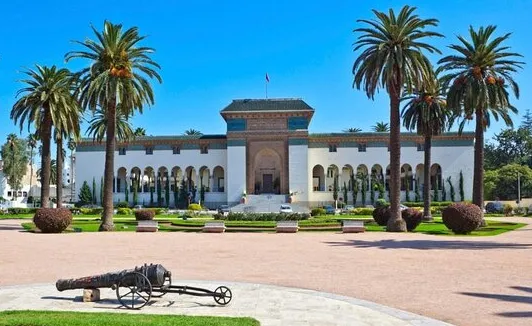
What makes the plaza visually striking is its exceptional architectural harmony. Henri Prost and his contemporary architects championed a unique design philosophy known as the Mauresque style (or Neo-Moorish Revival). This style brilliantly fused traditional Hispano-Moresque motifs—such as horseshoe arches, intricate zellige tilework, geometric cedar wood carvings, and grand interior courtyards—with the clean lines, rigid symmetry, and functional scale of European Art Deco and modernism.
As you walk along the perimeter of the square, you can marvel at several architectural landmarks that encapsulate this historic design movement:
-
The Wilaya Prefecture (City Hall): Designed by Marius Boyer and completed in 1937, this massive building houses the regional governor’s office. Its most defining feature is a towering, minimalist clock tower that rises high above the Casablanca skyline, blending traditional Moroccan minaret proportions with classic interwar design. Inside, the building hides an exquisite double-tiered gallery adorned with traditional stone carvings and vibrant tiles.
-
The Palace of Justice (Tribunal de Première Instance): Standing proudly on the eastern side of the plaza, this structural masterpiece was designed by Joseph Marrast and completed in 1923. Its entrance is framed by a massive, deeply recessed monumental arch inspired by imperial Moroccan city gateways, flanked by beautifully manicured green hedges and stone steps.
-
The Central Post Office (Grande Poste): Built in 1920 by Adrien Laforgue, this building greets visitors with a stunning exterior arcade. Take a closer look at its main entrance and upper facade to admire the brilliant blue and gold zellige mosaics that elevate this everyday administrative building into a breathtaking piece of public art.
-
Bank Al-Maghrib: Constructed in 1937 by Edmond Brion, the central bank building exhibits a slightly more restrained, geometric Art Deco aesthetic while still maintaining the stone-carved elegance that unifies the entire square.
-
The Grand Théâtre de Casablanca (CasArts): Representing the square's modern evolution, this multi-billion dirham project sits on the western edge. Designed by French architect Christian de Portzamparc and Moroccan architect Rachid Andaloussi, the theater features a contemporary white facade resembling fluid geometric sails. It beautifully echoes the classic white architecture of Casablanca while introducing cutting-edge 21st-century modernism to the historical plaza.
Essential Visitor Information
To help you seamlessly plan your visit to this magnificent landmark, here is a breakdown of all the practical, essential travel details you will need:
Preparation: What to Wear and What to Bring
A successful day of urban exploration in Casablanca requires a bit of thoughtful preparation. Because Mohammed V Square is an open-air environment surrounded by active government and judicial buildings, you should pack and dress appropriately for both the climate and the local culture.
What to Wear?
Morocco is a conservative, predominantly Muslim country. While Casablanca is the most modern and cosmopolitan city in the nation, dressing modestly is still highly recommended as a sign of cultural respect and to avoid unwanted attention.
-
For Women: Opt for loose-fitting, breathable clothing. Maxi dresses, loose trousers, linen pants, and blouses that cover the shoulders and chest are ideal. While you do not need to cover your head, avoiding short shorts, miniskirts, and crop tops will make your experience much more comfortable.
-
For Men: Lightweight trousers, chinos, or knee-length tailored shorts paired with a polo shirt or a breathable t-shirt are perfect.
-
Footwear: The plaza is expansive and features newly laid stone paving, while the surrounding downtown area has uneven sidewalks. Comfortable, closed-toe walking shoes or supportive sandals are a must. Avoid high heels.
-
Sun Protection: Casablanca enjoys plenty of sunshine year-round. A wide-brimmed hat, polarized sunglasses, and a good application of sunscreen are essential, especially if you visit during the midday heat when shade in the center of the plaza is scarce.
What to Bring?
Keep your daypack light but well-stocked with these urban exploration essentials:
-
Cash (Moroccan Dirhams): Bring small denominations (coins and 10, 20, or 50 MAD notes). You will need cash to buy birdseed from local vendors, purchase a bottle of water, or tip a taxi driver.
-
A Camera or Smartphone: The architectural details and the swirling flocks of pigeons offer incredible photography opportunities.
-
Hand Sanitizer or Wet Wipes: If you plan on feeding the pigeons, you will definitely want to sanitize your hands immediately afterward.
-
A Reusable Water Bottle: Staying hydrated is crucial, particularly in the summer months.
-
A Cross-body Bag: To deter opportunistic pickpockets in crowded areas, a secure bag that stays in front of your body is highly recommended.
The Vibe: Experiencing the Square by Day and Night
One of the most magical aspects of visiting this public space is how drastically its energy shifts depending on the time of day you choose to arrive.
The Daytime Atmosphere: The "Pigeon Square"
If you visit during the morning or early afternoon, you will experience the square at its most energetic and functional. Because it houses the legal and municipal core of the city, you will see local lawyers in traditional black robes hurrying toward the Palace of Justice, couriers moving briskly past the post office, and business professionals grabbing espresso at nearby sidewalk cafés.
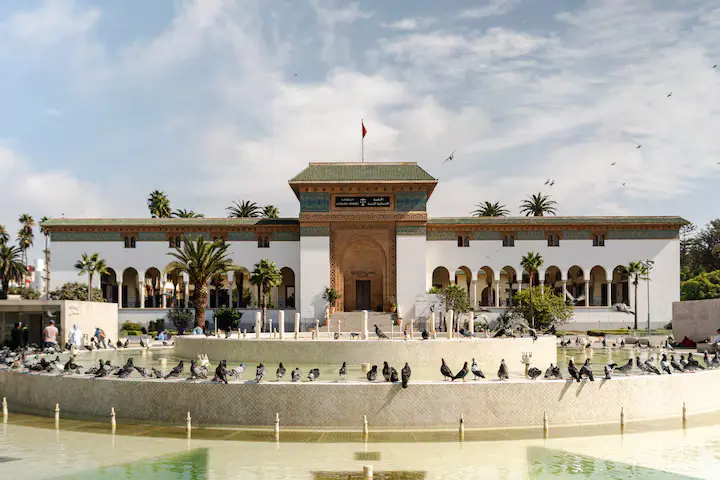
However, the real daytime rulers of the plaza are its thousands of avian residents. The heavy presence of these birds has earned the landmark its famous local nickname: Place aux Pigeons (Pigeon Square). Local vendors set up small wooden carts around the grand circular fountain to sell tiny bags of grain and corn to tourists and local children. Tossing a handful of grain into the air triggers a dramatic, swirling cloud of wings—making for an iconic, classic Casablanca photo opportunity.
The Nighttime Transformation: A Local Living Room
As the sun drops below the Atlantic horizon and the corporate workday comes to a close, the plaza drops its formal, administrative persona. In the evening, Mohammed V Square transforms into a vibrant, open-air community living room.
The grand central fountain, originally installed in 1976 and later updated, becomes the evening's main attraction. It lights up in an array of vibrant, shifting colors, casting a warm, shimmering glow across the polished stone pavement. String lights illuminate the grand archways of the surrounding colonial architecture, and the modern facade of the Grand Théâtre glows brightly against the night sky.
During these hours, Moroccan families come out in droves. You will see parents pushing strollers, teenagers zooming across the wide pedestrian zones on rollerblades, and couples sitting on stone benches enjoying the cool ocean breeze blowing in from the coast. It is the absolute perfect time to grab a Moroccan mint tea or a sweet pastry from a nearby vendor, sit back, and simply take in the authentic, joyous rhythm of local life.
Expert Advices for a Perfect Visit
To elevate your experience from that of a standard tourist to a savvy traveler, keep these expert pieces of advice in mind:
-
Utilize the Tramway: Do not bother trying to navigate a rental car through Casablanca's notoriously chaotic downtown traffic. The city's modern tram system (Line 1) drops you off right at the Place Mohammed V station. It is cheap (around 7 MAD), air-conditioned, and highly efficient.
-
Look Up and Zoom In: When photographing the buildings, don't just take wide shots. Use your camera's zoom to capture the incredible details of the zellige tilework, the carved wooden eaves, and the wrought-iron balconies. The beauty of the Mauresque style lies in its microscopic details.
-
Combine with a Medina Visit: Because the square is relatively close to the Old Medina, it makes sense to combine the two in a single morning or afternoon. Start at the square to admire the French colonial architecture, then walk north to the Medina to experience pre-colonial Moroccan alleyways and markets.
-
Engage Politely: If you buy birdseed or a snack from a vendor, a simple “Salam Alaikum” (Peace be upon you) and “Shukran” (Thank you) will go a incredibly long way in generating goodwill and warm smiles.
Common Mistakes to Avoid
Even the most seasoned travelers can run into hiccups. Ensure your excursion to the city center remains stress-free by avoiding these common pitfalls:
1. Expecting to Tour the Interior of Government Buildings
A very common mistake made by first-time visitors is assuming they can freely walk inside the historic buildings, such as the Palace of Justice or the Wilaya Prefecture. Because these are active, high-security municipal, legal, and state facilities, the interiors are generally strictly closed to the general public and tourists.
2. Overlooking Traffic Safety
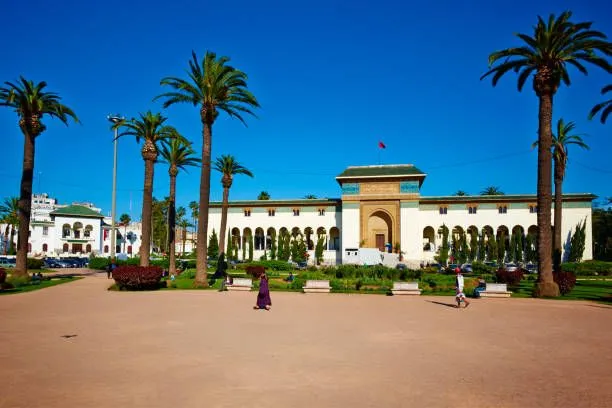
While the central plaza itself is fully pedestrianized, it is surrounded by some of Casablanca’s busiest multi-lane traffic arteries. Traffic in the economic capital moves incredibly fast, and local drivers do not always proactively yield to pedestrians, even at designated zebra crossings. Always use the designated pedestrian traffic lights, look both ways multiple times, and cross with a crowd of locals if possible.
3. Letting Your Guard Down Regarding Pickpockets
The central square is highly secure and heavily patrolled by municipal police officers. Violent crime is exceedingly rare. However, because it is a busy public transit hub, it can get very crowded. This environment makes it a target for opportunistic pickpockets. Keep your valuables zipped up and avoid flashing large amounts of cash.
Exploring the Surrounding Area
Because a thorough tour of the plaza takes roughly an hour, it serves as an excellent anchor point for a broader half-day walking tour of downtown Casablanca.
-
Place des Nations Unies: Located just a short walk north, this bustling square serves as the dividing line between the modern downtown and the historic Old Medina. It features bold modern structures and easy access to traditional shopping alleys.
-
Boulevard Mohammed V: Branching off from the city center, this historic thoroughfare is lined with stunning 1930s residential and commercial buildings. Walking down this street feels like an architectural museum tour, highlighting Casablanca's unique Art Deco heritage.
-
Parc de la Ligue Arabe: Heading slightly southwest, you will find the Arab League Park. This massive, beautifully restored urban green space is lined with towering palm trees and offers a quiet escape from the traffic. At its edge sits the striking Sacré-Cœur Cathedral, a decommissioned white Catholic church built in a spectacular Neo-Gothic style with Moroccan influences.
FAQ
Is the square safe for solo female travelers?
Yes, the plaza is generally very safe for solo female travelers. During the day and early evening, the space is heavily populated by local families, commuters, and visible security personnel. Dressing modestly will help minimize any unwanted attention or staring. At night, it is best to stick to the well-lit, busy pedestrian sections of the plaza.
Can I take photos of the police or the government buildings?
You are completely free to photograph the grand architecture of the buildings from the public plaza. However, as a strict rule of thumb across all of Morocco, you should never point your camera lens directly at police officers, military personnel, royal guards, or secure government checkpoints. Doing so can result in security personnel confiscating your camera or demanding you delete the images.
Are there public restrooms or dining options directly on the square?
There are no standalone public restrooms directly out on the open plaza. However, the streets immediately branching off the square are lined with numerous traditional Moroccan cafés, modern coffee shops, and fast-food outlets. You can easily purchase an inexpensive coffee or bottled water to use their customer restroom facilities.
Is the square fully accessible for travelers with mobility issues?
Yes. Following its massive urban renovation alongside the construction of the Grand Théâtre, the square is now entirely flat, open, and paved with smooth stone tiles. This makes it highly accessible for visitors using wheelchairs, mobility scooters, or pushing baby strollers. The adjacent tramway platforms are also equipped with gentle ramps for easy boarding.
Conclusion
No trip to Morocco's bustling economic capital is truly complete without spending some time taking in the grandeur, the architectural style, and the vibrant community spirit of its central plaza. From its complex origins as a French colonial administrative hub to its current, proud status as a monument to Moroccan sovereignty, the area perfectly distills the multi-layered history of this coastal metropolis.
By pairing your visit with an appreciation for the stunning Mauresque architecture, dressing comfortably and respectfully, avoiding the basic tourist pitfalls, and timing your trip to catch the illuminated evening fountains, you will experience an authentic slice of local life. Whether you are chasing the perfect photograph or simply looking for a place to rest and people-watch, visiting Mohammed V Square is an absolute must that will leave you with a deeper understanding of Casablanca's enduring charm.
From Casablanca's modern plazas to the magic of the Sahara, unforgettable adventures await. Join our next Morocco Group Tour today!