
The Eternal Splendor of the Ben Youssef Medersa: Marrakech’s Crown Jewel of Islamic Architecture
When navigating the sensory labyrinth of Marrakech’s ancient medina, where the air is thick with the scent of orange blossoms, cumin, and roasted coffee, you will eventually find yourself drawn toward a sanctuary of profound quietude. Tucked behind the bustling alleys of the northern medina lies the Ben Youssef Medersa, a breathtaking 16th-century Islamic college that stands as one of the most sublime achievements of Moroccan and Andalusian architecture. To step across its threshold is to leave the frenetic energy of the modern world behind and enter a realm where math, poetry, and devotion are chiseled indelibly into stone and cedar.
Historically serving as the intellectual and spiritual beating heart of the Maghreb, this majestic landmark has transformed over the centuries from a rigorous sanctuary of higher learning into a globally recognized cultural treasure. Today, it stands proudly as a must-visit destination for travelers, photographers, and history enthusiasts from around the world. Whether you are mesmerized by the hypnotic geometry of its mosaic tilework or fascinated by the austere, contemplative life once led by its student residents, a visit here offers an unforgettable journey into the golden age of Moroccan civilization.
Plan your dream trip and Discover more hidden gems, historic riads, and cultural highlights in Marrakech with Marrakech Excursions.
The Origins and Evolution: Who Built This Masterpiece and Why?
To truly appreciate the grandeur of the Ben Youssef Medersa, one must trace its roots back to the medieval dynasties that shaped the cultural and political topography of North Africa. While the structure we see today is primarily a product of the 16th-century Saadian dynasty, the foundational history of the college begins much earlier, during the Marinid period.
The Marinid Foundation
The original institution on this site was established in the 14th century (around 1331–1348) by the Marinid Sultan Abu al-Hasan. The Marinids, who ruled from their capital in Fez, were renowned patrons of the arts, literature, and jurisprudence. They viewed the construction of madrasas (Islamic colleges) not only as acts of religious piety but also as strategic political tools. By funding these institutions, the sultans could train a loyal, highly educated class of administrative officials, judges (qadis), and religious scholars (ulama) versed in Maliki Islamic law.
The college was named after the adjacent Ben Youssef Mosque, which had been built centuries earlier by the Almoravid emir Ali ibn Yusuf. For generations, this early iteration of the school served as a modest but vital center of learning in Marrakech, providing free education and lodging to young men coming from rural provinces and distant corners of the kingdom.
The Saadian Rebirth
By the mid-16th century, the original Marinid structure had fallen into severe disrepair, mirroring the decline of the dynasty itself. The rise of the Saadian dynasty brought a renewed wave of architectural ambition and political centralization to Morocco. Recognizing the symbolic and practical value of the site, the Saadian Sultan Abdallah al-Ghalib commissioned a complete and lavish reconstruction of the college between 1564 and 1565 CE.
Abdallah al-Ghalib was a monumental builder who sought to assert Marrakech’s status as a glittering imperial capital. He did not merely repair the old school; he completely reimagined it on a grand, unprecedented scale. Utilizing the finest artisans, calligraphers, and materials from across the region, he erected a sprawling quadrilateral complex spanning roughly 1,680 square meters. Upon its completion, it claimed the title of the largest Islamic college in North Africa, capable of housing upwards of 800 students simultaneously.
For nearly four centuries, the institution functioned as a bastion of intellectual fervor. It was a place where young minds did not just memorize the Qur'an, but deeply immersed themselves in advanced disciplines, including:
-
Arabic grammar and rhetoric (balagha)
-
Astronomy and mathematics
-
Islamic jurisprudence (fiqh)
-
Medicine and philosophy
The school finally closed its doors as an active educational facility in 1960. Recognizing its immense architectural and cultural value, the Moroccan government meticulously refurbished the building, opening it to the public as an official historical monument in 1982. Following a massive, multi-year conservation project completed recently, the site has been preserved with breathtaking precision for future generations.
Architectural Mastery: A Visual Symphony of Three Materials
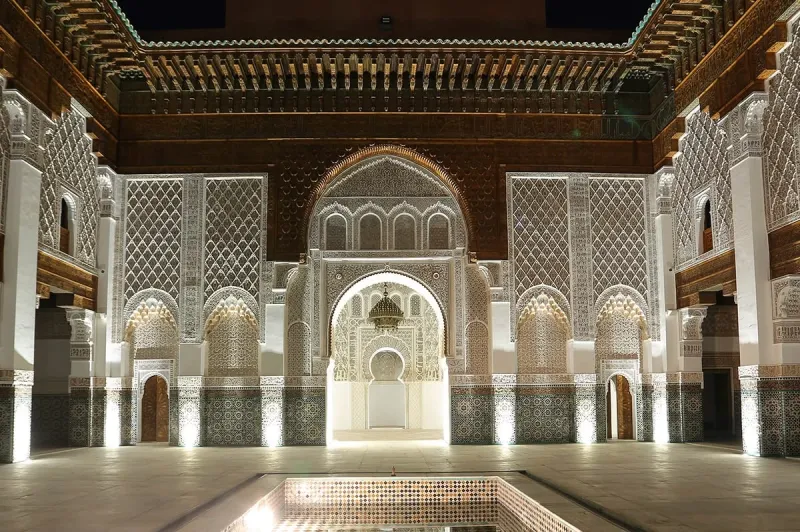
The architectural genius of the Ben Youssef Medersa lies in its rigorous adherence to traditional Moorish principles, characterized by a deliberate contrast between exterior austerity and interior opulence. From the outside street, the building presents nothing more than windowless, high mud-brick walls, revealing absolutely nothing of the beauty within. This design choice reflects a core Islamic architectural philosophy: focusing beauty inward toward the spiritual center rather than flaunting it to the secular world outside.
Upon passing through the dark, winding entrance corridor—a architectural tactic deliberately designed to slow the visitor down and transition their mind from the chaotic streets to a state of calm reflection—you emerge into the main courtyard. Here, your eyes are met with a dazzling orchestration of three primary materials: zellij (mosaics), stucco, and cedarwood.
1. The Zellij Tilework
The lower third of the courtyard walls is blanketed in exquisite zellij—hand-cut, glazed terracotta tile fragments arranged into complex, dizzying geometric patterns. Because traditional Islamic art avoids the depiction of sentient beings (aniconism), artists poured their creative genius into mathematical abstraction.
The color palette used in the tilework is deeply symbolic:
-
Ochre and Yellow: Representing the blazing Moroccan sun and the surrounding desert sands.
-
Cobalt Blue: Signifying the infinite expanse of the heavens.
-
Emerald Green: Representing paradise and the traditional color of Islam.
-
White: Embodying purity, clarity, and peace.
Each tiny tile piece was shaped by master craftsmen using specialized hammers, fitting together with such microscopic precision that the seams are barely visible to the naked eye.
2. The Carved Stucco (Gebs)
Rising above the vibrant tilework are expansive bands of intricate stucco work, known locally as gebs. Made from a mixture of local gypsum, marble dust, and lime, this plaster was carved entirely by hand while still damp.
The stucco surfaces are dense with muqarnas (honeycomb or stalactite-like vaulting) that create an extraordinary play of light and shadow as the sun moves across the sky. Interwoven among the floral arabesques are elegant bands of calligraphic inscriptions written in the flowing Thuluth and angular Kufic scripts. These inscriptions include poetic praise for Sultan Abdallah al-Ghalib, verses from the Qur'an, and prayers invoking peace upon the students who walked these halls.
3. The Cedarwood Carvings
Capping the top sections of the walls and forming the massive overhanging eaves are heavy beams of Moroccan cedarwood, sourced from the high forests of the Atlas Mountains. Cedar was prized by Saadian architects not only for its rich, fragrant scent—which still lingers in the air on hot days—but also for its exceptional durability and resistance to pests.
Artisans carved the dark wood into heavy, layered friezes, cornices, and window screens (mashrabiya). The combination of the dark, warm wood tones juxtaposed against the pale, delicate stucco and the brilliant, glossy tilework creates a perfectly balanced visual weight that keeps the massive courtyard from feeling overwhelming.
Exploring the Space: From the Serene Courtyard to the Micro-Cells.
The Central Courtyard and Reflective Pool
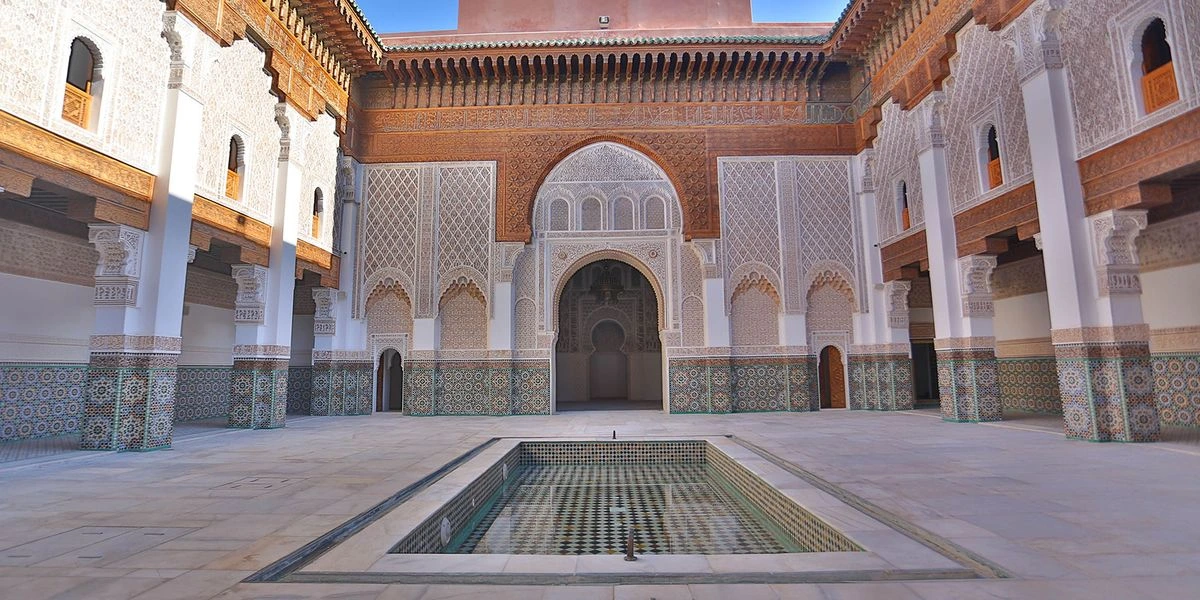
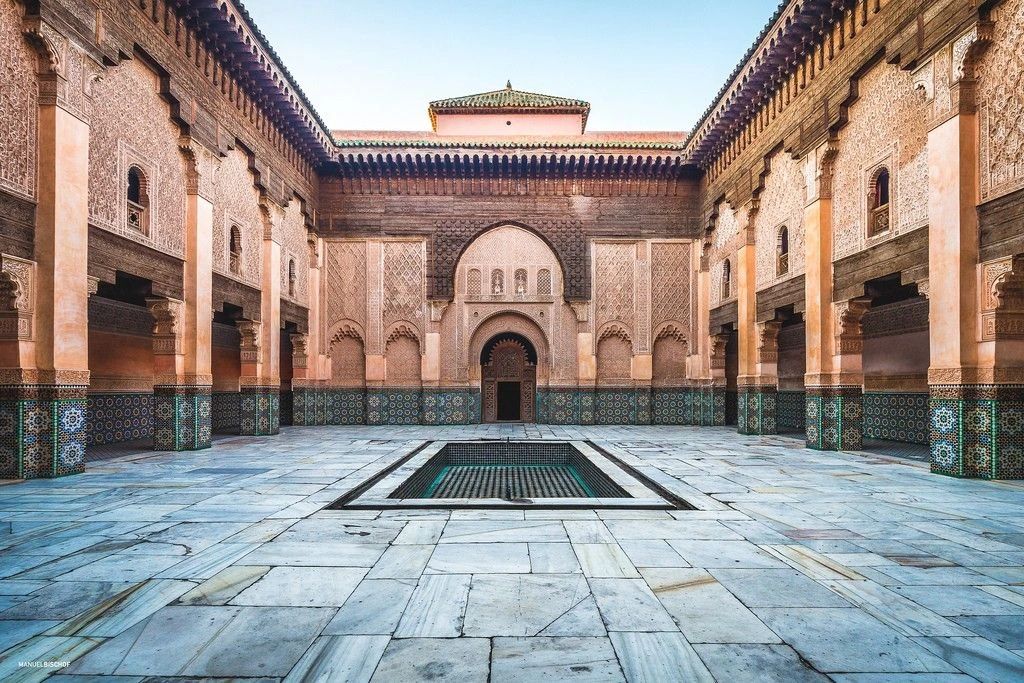
Measuring approximately 15 by 20 meters, the central courtyard is paved with smooth, pale Italian marble that remains remarkably cool underfoot even in the peak of summer. Dominating the center of the space is a long, shallow rectangular water basin.
This pool was not merely decorative; it served a vital practical and spiritual purpose. It provided water for students to perform wudu (ritual ablutions) before prayer, while its mirror-like surface reflected the brilliant blue sky and the intricate upper carvings of the building. Visually, the water grounds the soaring vertical walls, doubling the architectural beauty through its pristine reflection and infusing the courtyard with a palpable sense of peace.
The Prayer Hall and the Mihrab
Situated at the far end of the courtyard, directly opposite the entrance axis, lies the magnificent prayer hall. This rectangular room is divided by two rows of heavy marble columns that support a spectacular, multi-tiered cedarwood dome overhead.
The focal point of the prayer hall is the mihrab—the semicircular niche indicating the direction of Mecca. The archway surrounding the mihrab represents the pinnacle of Saadian decorative art. It is framed by incredibly dense, multi-layered carvings of pure white stucco, featuring a magnificent border of Kufic script containing verses from Surah an-Nur (The Chapter of Light). Standing in this hall, one can easily imagine hundreds of students kneeling on woven reed mats, their voices blending into a low, rhythmic hum as they recited texts under the soft glow of oil lamps.
The Student Dormitories: A Study in Humility
While the public spaces of the college radiate luxury, the residential quarters located on the upper levels offer a stark, humbling contrast. Accessible via dark, narrow staircases off the main vestibule, the upper floor contains a labyrinth of 132 tiny student rooms (cells) arranged around several small, secondary light wells.
These cells are astonishingly compact, often measuring no more than a few square meters. Many feature low, wooden loft platforms where students would sleep, leaving the floor space below free for a small writing desk and boxes of books. In these cramped quarters, up to four or five students would live, cook, and study together.
Visiting these rooms is an essential part of the experience. Peeking through the small, slatted mashrabiya windows down into the sunlit main courtyard gives you a fascinating, intimate perspective on what daily life looked like for an aspiring scholar centuries ago. It underscores the immense dedication required of these young men, who swapped all physical comfort for the privilege of accessing higher knowledge.
Why the Ben Youssef Medersa is a Premier Global Tourist Attraction?
In the modern era, the Ben Youssef Medersa has transitioned effortlessly from an educational powerhouse into one of Morocco's most iconic and celebrated tourist attractions. But what exactly draws hundreds of thousands of international visitors through its doors each year?
A Living Textbook of Islamic Design
For architects, artists, and historians, the site is widely considered the absolute pinnacle of Saadian design. It encapsulates an entire era of artistic evolution, serving as a pristine, remarkably preserved showcase of architectural techniques that were perfected over hundreds of years across North Africa and Southern Spain. Unlike other historic sites that have been heavily modernized or left to crumble, this complex retains an authentic, palpable sense of antiquity that makes history come alive.
A Photographer's Paradise
In the age of visual travel, the building has earned a massive global reputation as an unparalleled destination for photography. The interaction between sunlight, shadow, and architectural geometry creates an endlessly shifting canvas throughout the day.
Whether it is capturing the perfect symmetrical reflection of the carved eaves in the central pool, framing a portrait through one of the horseshoe-shaped archways, or capturing the soft, golden light filtering into the upper-floor brick corridors, the site provides infinite creative possibilities.
An Antidote to Medina Fatigue
Marrakech is a thrilling city, but its relentless energy can be exhausting. The Medina is a whirlwind of motorbikes, assertive vendors, vibrant colors, and non-stop noise. For many travelers, this sanctuary serves as a vital emotional and physical reset button. The thick walls completely insulate the interior from the sounds of the surrounding souks, offering a serene, contemplative space where visitors can slow down, sit quietly on the cool marble, and decompress.
Planning Your Visit: Logistics, Pricing, and Practical Guide
To ensure you get the absolute most out of your journey to this historical marvel, it helps to know the practical logistics beforehand. The monument is exceptionally well-managed, making it highly accessible for independent travelers.
Location and How to Find It
The monument is located at Ben Youssef Square (Place Ben Youssef), right next to the historic Ben Youssef Mosque in the northern half of the Medina.
Because the streets of Marrakech’s old city are famously non-linear and lack clear signage, finding it can be an adventure.
-
On Foot: It is roughly a 10-to-15-minute walk north from the main square, Jemaa el-Fna. Follow the main thoroughfare of Souk Semmarine, keeping straight as it transforms into Souk El Kebir, and follow the occasional small signs pointing toward the "Musée de Marrakech" or "Medersa."
-
Navigation Tip: Download an offline map application (like Google Maps or Maps.me) before you venture deep into the souks, as cellular signals can be spotty in the narrow, covered alleys.
Opening Hours
The site is open to the public seven days a week, though hours can fluctuate based on the time of year and religious calendars.
Standard Hours, 9:00 AM – 7:00 PM, Last entry is generally 30 minutes before closing.
Holy Month of Ramadan, 9:00 AM – 4:30 PM, Hours are compressed to allow staff to return home for Iftar.
Best Time to Visit
Timing your visit perfectly can completely transform your experience from a crowded, rushed walkthrough to a magical, deeply spiritual encounter.
-
The Early Morning Golden Hour (9:00 AM – 10:30 AM): This is universally considered the best time to visit. Not only will you beat the large, organized cruise and day-trip tour groups that arrive closer to midday, but the early morning sun hits the upper cedar carvings beautifully, filling the courtyard with a soft, gentle glow. It is also your best chance to capture pristine photos of the central pool without crowds of people in the background.
-
The Late Afternoon Soother (5:30 PM – 7:00 PM): As the day winds down, the intense heat breaks, and the shadows lengthen across the courtyard. Most tour groups have departed by this time to prepare for dinner, leaving the monument remarkably quiet and peaceful.
-
Best Days of the Week: Aim for a Tuesday, Wednesday, or Thursday morning. Weekends tend to see a higher influx of domestic tourists and regional weekend travelers.
Recommended Duration
To properly absorb the intricate details, explore the upper-floor dormitories, and spend time simply sitting in reflection, you should allocate between 45 minutes to 1.5 hours for your visit. It is not a massive site geographically, but its value lies in its staggering density of detail. Rushing through it in 20 minutes means missing the subtle artistic nuances that make it so special.
Essential Visitor Advice: Dressing, Packing, and Avoiding Mistakes
Visiting a historical, religiously significant site in Morocco requires a bit of cultural awareness and physical preparation. Following these simple guidelines will help ensure a smooth, respectful, and highly enjoyable visit.
What to Wear
While the building is no longer an active, functioning religious school or mosque, it remains a highly revered monument of Islamic history and heritage. Out of respect for the local culture and the spiritual history of the space, visitors should dress modestly.
-
For Women: Opt for clothing that covers your shoulders and knees. Maxi dresses, long skirts, loose-fitting linen trousers, and t-shirts are ideal. You do not need to cover your hair or wear a headscarf (hijab) to enter this site, as it is a museum rather than an active house of worship.
-
For Men: Avoid sleeveless tank tops or overly short athletic shorts. Standard t-shirts, polo shirts, and trousers or long shorts that reach the knee are perfectly acceptable.
-
Footwear: You will be doing a significant amount of walking over historic stone and smooth marble tiles. Wear comfortable, broken-in walking shoes or supportive sandals. There is no requirement to remove your shoes when walking through the central courtyard or the historic student cells.
What to Bring
-
Moroccan Dirham Cash: As mentioned, the ticket office is strictly cash-only. Make sure you have small-denomination bills or coins ready, as the counter staff sometimes struggle to make change for large 200 MAD bills early in the morning.
-
A Wide-Angle Lens: If you are traveling with a DSLR or mirrorless camera, a wide-angle lens is an absolute game-changer here. The courtyard and the student cells are tightly enclosed spaces; a wide lens allows you to capture the full vertical scale of the walls and the expansive reflections in the pool.
-
A Bottle of Water: The courtyard is completely open to the Moroccan sky, and the marble pavement can radiate heat intensely during midday. Bring a bottle of water to stay hydrated, though remember to consume it discretely out of respect if you happen to be visiting during the fasting hours of Ramadan.
Common Visitor Mistakes and How to Avoid Them
-
Mistake 1: Missing the Upper Floor Entirely
It sounds surprising, but many independent travelers walk into the central courtyard, marvel at the carvings, take a few selfies by the pool, and walk right out, completely unaware that a second floor exists. Because the doorways leading to the staircases are tucked away in the dark corners of the entrance vestibule, they can easily be overlooked.
How to avoid it: Once you enter the complex, explore the darker side corridors flanking the main entrance before you dive into the courtyard. Look for the narrow brick stairwells that lead upward to the network of student dormitories.
-
Mistake 2: Treating the Site Like a Standard Visual Backdrop
With the rise of social media, it is common to see visitors treating the central pool purely as an aesthetic backdrop, spending their entire visit posing for dozens of photos without taking a single moment to look up, read the history, or absorb the atmosphere. This can sometimes create a chaotic, noisy environment that disrupts the peace of the space for others.
How to avoid it: Take your photos early, and then intentionally put your phone or camera away in your bag for at least fifteen minutes. Find a quiet corner along the shaded lateral galleries, sit down on the cool marble, and look deeply at the layers of stucco and wood. Listen to the silence of the space and try to imagine the centuries of intense human focus, study, and devotion that unfolded right where you are sitting.
FAQ
Can I book my admission tickets online in advance?
Currently, individual general admission tickets cannot be purchased online through an official government portal; they must be bought on-site at the physical ticket office using cash. However, if you book a licensed, guided walking tour of Marrakech through an authorized travel agency or tour provider, your entry ticket is almost always included in the tour price, allowing you to skip the regular ticket queue.
What is the difference between a Madrasa (Medersa) and a Mosque?
A mosque (masjid) is a dedicated house of communal prayer and worship where religious services, Friday sermons, and spiritual gatherings take place. A madrasa (medersa in Moroccan transliteration) is an educational institution or college. While it always contains a dedicated prayer hall, its primary function is academic—serving as a school, university, and dormitory where students live and study a comprehensive curriculum of religious and secular sciences.
Is it safe to visit the surrounding northern medina area?
Yes, the area surrounding the monument is generally very safe for tourists during daylight hours, as it is heavily trafficked by locals and international visitors alike. However, because the alleys are incredibly narrow and crowded, pickpocketing can occasionally occur. Keep a close eye on your personal belongings, avoid carrying large amounts of exposed cash, and keep your backpack zipped and secure.
Conclusion: A Timeless Legacy Etched in Stone
Long after you have departed the red walls of Marrakech, your memories of the Ben Youssef Medersa will likely remain vivid and clear. In a world that often prizes speed, transience, and constant change, this extraordinary monument serves as a powerful, enduring reminder of what can be achieved when human artistic genius, mathematical precision, and deep spiritual devotion converge. It stands not merely as a relic of a bygone imperial era, but as an active, breathing testament to Morocco's rich intellectual heritage. By stepping into its sun-drenched courtyard, you don't just view history—you become a small part of its ongoing, centuries-old story.
Want to see these architectural wonders without the stress? Discover hidden gems, expert local guides, and historic riad stays with our Morocco Group Tours.