
Qaitbay Citadel - Guide to Alexandria’s Timeless Fortress
Introduction: A Fortress Standing Against Time and Tide
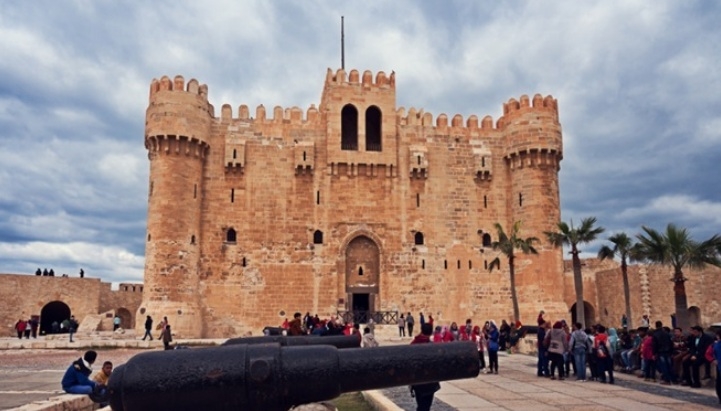
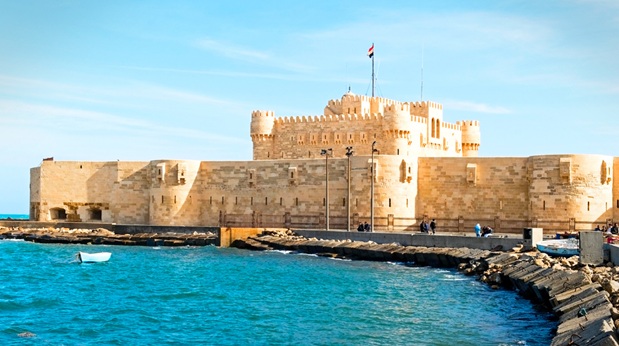
Qaitbay Citadel—also known as the Citadel of Sultan Al-Ashraf Qaitbay—stands proudly on the eastern point of Alexandria’s harbor, guarding the Mediterranean coastline with unrivaled grace and historical depth. This 15th-century masterpiece is more than just a military fortress; it is a symbol of Alexandria’s resilience, a place where history meets breathtaking scenery, and one of Egypt’s most celebrated coastal landmarks. Overlooking turquoise waves and positioned on the legendary site of the ancient Lighthouse of Alexandria, the citadel remains a powerful reminder of Egypt’s strategic maritime legacy.
Visiting Qaitbay Citadel is not simply a walk through old walls—it’s a journey across centuries of battles, rulers, maritime culture, and architectural brilliance. With its towering stone façade, maze-like interior, dramatic views, and fascinating museum spaces, the citadel offers an immersive experience that captures the essence of Alexandria’s past and present.
The Historical Importance of Qaitbay Citadel
To fully understand the significance of this mighty fortress, we must step back into the 15th century, at a time when Egypt’s Mamluk rulers sought new ways to protect their vast territories from growing regional threats. Sultan Al-Ashraf Qaitbay, known for his leadership skills and architectural vision, recognized Alexandria as Egypt’s first line of defense against naval attacks. The Mediterranean was a turbulent arena, with European powers and Ottoman forces vying for influence along the African shores.
Qaitbay quickly realized that the city’s coastal defenses needed reinforcement, especially after several invasions had left parts of Alexandria vulnerable. In response, he commissioned an elaborate defensive complex on Pharos Island, strategically positioned at the harbor’s entrance. This location was no ordinary patch of land. It was the exact site where the magnificent Lighthouse of Alexandria—one of the Seven Wonders of the Ancient World—once stood before earthquakes reduced it to ruins.
The choice of location was brilliant. Not only did the ruins offer leftover stones suitable for construction, but the position itself provided unparalleled visibility across the Mediterranean. Any ship attempting to approach Alexandria would fall under the watchful eyes of soldiers stationed at the citadel.
The fortress was completed in 1477 AD and quickly became the most significant defensive structure in the region. It stood as Egypt’s maritime shield for centuries, enduring wars, invasions, political shifts, and natural disasters, all while maintaining its imposing presence on the coastline.
Architecture: A Blend of Strength, Balance, and Mamluk Elegance
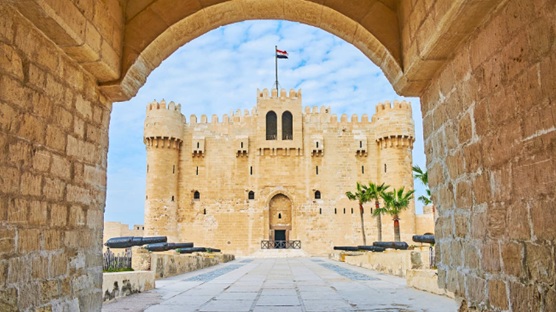
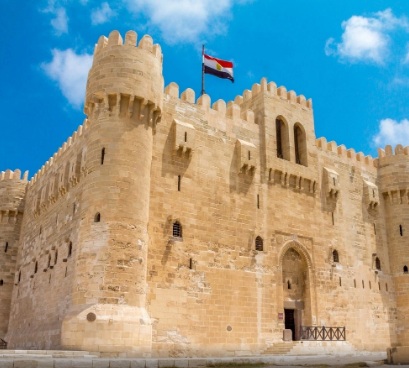
Although Qaitbay Citadel was designed for military purposes, its construction reflects the artistic sophistication of the Mamluk era. The fortress is square-shaped, built from thick limestone blocks that withstand wind, sea mist, and saltwater erosion. Its exterior walls rise in formidable layers, with rounded towers at each corner to maximize defense capabilities.
Upon approaching the citadel, visitors are immediately captivated by the towering façade, complete with decorative stone carvings, shields, and inscriptions that honor Sultan Qaitbay. The main gate, framed by two massive defensive towers, leads into a structure that feels both monumental and intricate.
Inside, the citadel is organized into three primary levels:
1. The Lower Level – Defense and Storage
This level was crucial for the citadel’s strategic operations. It included:
-
Storage rooms for food, water, and weaponry
-
Soldiers’ living quarters
-
A small mosque designed for spiritual practice during long periods of duty
The thick walls and narrow corridors were designed to confuse invaders while protecting stationed soldiers.
2. The Middle Level – Passageways, Guarding Points, and Inner Chambers
The second level functioned as the main operational center. Here, soldiers monitored the harbor, communicated with other coastal stations, and coordinated defense strategies. The interconnected passageways reveal the careful planning behind Mamluk military architecture.
3. The Upper Level – The Heart of Defense
The rooftop and upper towers served as the fortress’s most important vantage points. From here, lookouts could scan the horizon for approaching ships long before they reached the harbor. The rooftop also houses one of the citadel’s most photographed areas—a large open platform with panoramic views of the Mediterranean Sea and Alexandria’s skyline.
The balance of beauty and function in Qaitbay’s design shows that the Mamluks built not only to defend but also to inspire admiration.
.jpg)
The Lighthouse of Alexandria: A Wonder Reborn as a Fortress
One of the most fascinating aspects of Qaitbay Citadel is its connection to the ancient Lighthouse of Alexandria, built over 2,000 years ago during the Ptolemaic era. The lighthouse once stood nearly 120 meters tall and was considered the tallest human-made structure of its time. It guided ships safely into Alexandria’s harbor and became one of the Seven Wonders of the Ancient World.
By the time of Sultan Qaitbay, the lighthouse had already suffered severe damage from earthquakes in 956, 1303, and 1323. When the final collapse occurred, only stones, fragments, and foundations remained. These remnants were later used in the construction of the new citadel.
Thus, Qaitbay Citadel is not just a fortress—it is a continuation of a world wonder. Visiting the site feels like walking through multiple layers of history, where ancient and medieval worlds intersect.
Life Inside the Citadel: Soldiers, Strategy, and Survival
During its operational years, Qaitbay Citadel was alive with daily military activity. The fortress housed hundreds of soldiers, along with commanders, maintenance workers, and religious scholars responsible for the mosque. Daily life included:
-
Guard shifts and surveillance
-
Training routines
-
Maintenance of weapons and supplies
-
Religious practices in the mosque
-
Repairing walls and coastal defenses
-
Communication with nearby watchtowers and military posts
Living conditions were practical and efficient but far from luxurious. Soldiers slept in shared quarters, often working in difficult conditions exposed to sea winds, storms, and long periods of watch duty. Their presence was essential; the security of the city depended on the fortress remaining constantly alert.
The Citadel Through the Centuries: Decline, Damage, and Restoration
Qaitbay Citadel continued to defend Egypt long after the Mamluk period. Under the Ottoman Empire, the fortress was upgraded with cannons and additional artillery spaces. However, over time, the rise of modern warfare made medieval fortresses less effective.
In 1798, during the French invasion led by Napoleon Bonaparte, the citadel suffered heavy damage from artillery bombardment. Although it remained structurally sound, many internal sections were weakened.
By the 19th century, the fortress had become largely neglected until Muhammad Ali Pasha—founder of modern Egypt—launched a major restoration project. He recognized the citadel as both a historical treasure and a potential military base. New defensive lines and modern weapon placements were added to adapt to changing warfare technologies.
In the 20th century, Egypt initiated further preservation efforts. The Supreme Council of Antiquities worked on reinforcing the walls, restoring decorative inscriptions, and protecting the structure from sea erosion. Today, the citadel stands fully restored and open to visitors, offering one of the best-preserved examples of medieval Islamic military architecture in the Mediterranean.
Exploring Qaitbay Citadel: What to See and Experience
A tour inside Qaitbay Citadel is a journey through stone passages, ancient vantage points, and breathtaking sea views. Highlights include:
1. The Main Gate and Entrance Passage
The imposing entrance is decorated with Arabic calligraphy, shields, and geometric carvings. Walking through the gate feels like stepping into another era.
2. The Central Courtyard
The heart of the citadel, surrounded by thick stone walls and arched passages, offers a peaceful atmosphere despite its historic military purpose.
3. The Mosque of Qaitbay
Located on the lower level, the small mosque served soldiers stationed at the fortress. It remains beautifully preserved and features a simple yet elegant Mamluk design.
4. The Roof and Watchtowers
The rooftop is the citadel’s crown jewel. Visitors enjoy 360-degree views of:
-
The Mediterranean Sea
-
Alexandria’s Corniche
-
Fishing boats and waves crashing against the rocks
-
The harbor and coastline
It is one of the most scenic viewpoints in Egypt.
5. Museum Displays and Weapons Exhibits
Some rooms house exhibits showcasing historical weapons, cannons, maritime artifacts, and photographs documenting restoration efforts.
The Surrounding Area: Alexandria’s Coastal Beauty
The citadel is located at the tip of the Alexandrian Corniche, a lively and scenic stretch of coastline frequented by locals and tourists. The moment you step outside the fortress walls, you are greeted by the fresh sea breeze and panoramic views. The location is excellent for photography, sunset watching, and enjoying seafood restaurants nearby.
Many visitors combine their trip to Qaitbay Citadel with visits to:
-
The Alexandria Aquarium
-
The Corniche
-
The Maritime Museum
-
The Bibliotheca Alexandrina
-
Nearby beaches and cafés
The area is safe, vibrant, and perfect for leisurely walks.
Why Qaitbay Citadel Is a Must-Visit in Alexandria
There are countless reasons why travelers fall in love with this fortress:
-
It is one of the best-preserved medieval fortresses in Egypt.
-
The citadel stands on the legendary site of the Lighthouse of Alexandria.
-
Its architecture, inscriptions, and towers reflect the brilliance of Mamluk engineering.
-
The rooftop view is one of the most beautiful in Egypt.
-
It offers an immersive blend of history, architecture, photography, and coastal charm.
-
It appeals to families, photographers, history lovers, and casual tourists alike.
Every corner of the citadel tells a story—of battles fought, civilizations that rose and fell, and the enduring power of the sea.
Qaitbay Citadel is far more than a stone fortress—it is a living monument that bridges Alexandria’s ancient grandeur with its medieval strength. From its connection to the Lighthouse of Alexandria to its beautiful architecture, breathtaking sea views, and rich history, the citadel offers an unforgettable experience for any traveler exploring Egypt’s northern coast.
Whether you wander through its historic chambers, climb to the rooftop for panoramic Mediterranean views, or simply enjoy the peaceful atmosphere of the harbor, Qaitbay Citadel promises a journey filled with discovery and inspiration.
Plan your visit today and experience the timeless beauty, history, and coastal magic of Alexandria’s iconic Qaitbay Citadel—one of Egypt’s most extraordinary treasures.