
The Resting Place of Morocco's Warrior King
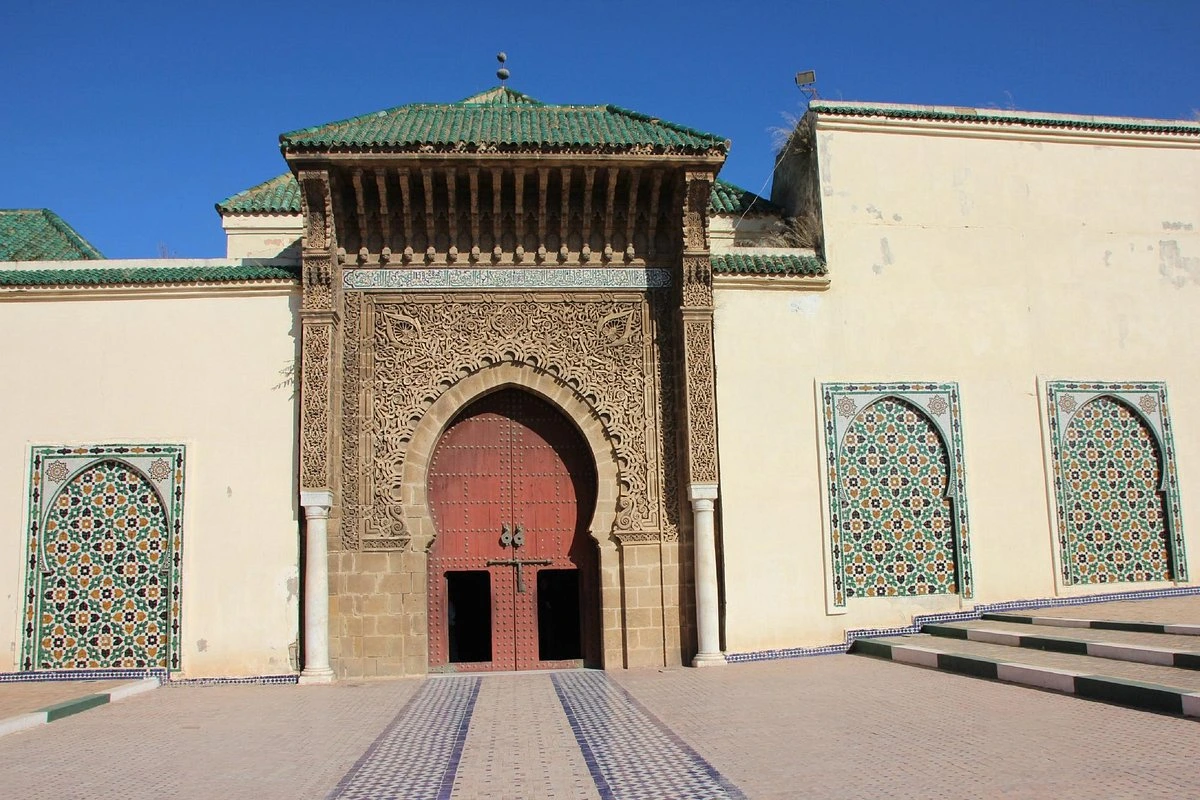
Set deep within the Imperial City of Meknes, the Mausoleum of Moulay Ismail is one of Morocco’s most compelling historical sites. Unlike the bustling, sensory overload of nearby Fez or Marrakech, stepping through the yellow arches of this 18th-century complex feels like crossing an invisible threshold into profound stillness.It serves as the final resting place of Sultan Moulay Ismail (1672–1727), the ruthless, visionary ruler who transformed Meknes from a modest provincial town into a fortress-capital designed to rival Versailles. Beyond its historical weight, the mausoleum is world-famous for another reason: it is one of the extremely rare active Islamic holy sites in Morocco open to non-Muslim visitors.
Whether you are traveling through the Imperial Cities on a grand tour or making a day trip from Fez.
The Verdict: Absolutely.
If you appreciate architecture, history, or sacred spaces, the Mausoleum of Moulay Ismail is an absolute must-see in Meknes.
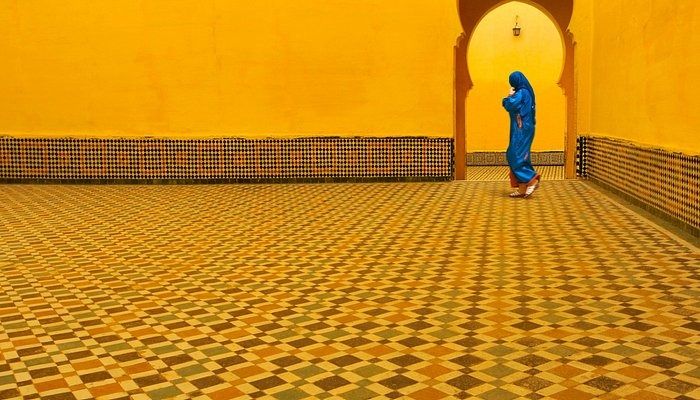
The site is intimate rather than sprawling, making it easy to visit without travel fatigue. What makes it stand out is the spatial transition: you move from stark, sun-drenched, butter-yellow outdoor courtyards into cool, dimly lit chambers adorned with some of the finest plasterwork (stucco), handcrafted cedar wood, and zellige (Moroccan mosaic tilework) in North Africa. Travelers planning their itineraries often look to explore more about best maroccon trips to see how Meknes fits perfectly alongside Fez, Rabat, and Marrakech.
┌─────────────────────────────────────────────────────────┐
│                    VISITOR AT A GLANCE                  │
├─────────────────┬───────────────────────────────────────┤
│ Ideal Duration  │ 30 to 45 minutes                      │
│ Experience Type │ Sacred / Architectural / Historical   │
│ Accessibility   │ Open to Non-Muslims (Sanctuary entry) │
│ Cost Score      │ Free / Nominal donation               │
└─────────────────┴───────────────────────────────────────┘
The Blood, Iron, and Marble History
To understand the mausoleum, you have to understand the man buried beneath it.
Moulay Ismail ibn Sharif was the second ruler of the Alaouite Dynasty—the same dynasty that rules Morocco today. Reigning for 55 years, he remains one of the longest-ruling monarchs in African history. Known as the "Warrior King," Ismail was a commander of terrifying resolve. He unified Morocco by driving out the British from Tangier and the Spanish from Larache, while crushing internal tribal rebellions with a standing army of over 150,000 African soldiers known as the Black Guard (Abid al-Bukhari).
.jpg)
Why Meknes?
Ismail abandoned the traditional royal capitals of Fez and Marrakech, choosing Meknes as his seat of power. He forced tens of thousands of Christian slaves and local laborers to construct a colossal Imperial City bounded by 40 kilometers of towering defensive walls.
Built on a Palais de Justice
Ismail ordered his mausoleum built during his own lifetime, choosing a deeply symbolic location: the site of Meknes's former courthouse (Palais de Justice). The Sultan famously stated that he wished to be judged in death by his own people in his own court.
Construction was completed in 1703, 24 years before his death. When he finally died in 1727, he was buried here alongside one of his favorite wives, Lalla Khnata, and two of his sons.
Historical Irony: While Moulay Ismail’s reign was marked by iron-fisted discipline, intense military campaigns, and extreme violence, his final resting place is celebrated as one of the quietest, most serene spaces in all of Morocco.
What to Expect When You Arrive
Visiting the mausoleum is a sequence of gradual reveals. The architecture is deliberately designed to calm the senses as you move closer to the tomb.
[Outer Medina Street]
         │
         ▼
[Butter-Yellow Reception Hall & Fountains] ── (Courtyard 1)
         │
         ▼
[Paved Open-Air Courtyards] ─────────────── (Courtyards 2 & 3)
         │
         ▼
[Shoe Removal Threshold]
         │
         ▼
[The Sacred Antechamber & Patio] ────────── (Zellige & Muqarnas)
         │
         ▼
[View of the Royal Tomb Chamber] ────────── (Non-Muslim Viewing Area)

1. The Ochre & Yellow Antechambers
You enter off the street into a covered reception room painted a warm, buttercup yellow. Light pours in from central skylights, highlighting small marble wash fountains used for ritual ablution.
2. The Interconnected Courtyards
From the reception room, you pass through a series of quiet, roofless courtyards. The walls are simple, painted yellow, punctuated by horseshoe arches and topped with muqarnas (corbelled vaulting). Look closely at the marble columns lining these courtyards: many of them were pillaged directly from the nearby Roman ruins of Volubilis by Moulay Ismail’s builders.
3. The Indoor Patio & Antechamber
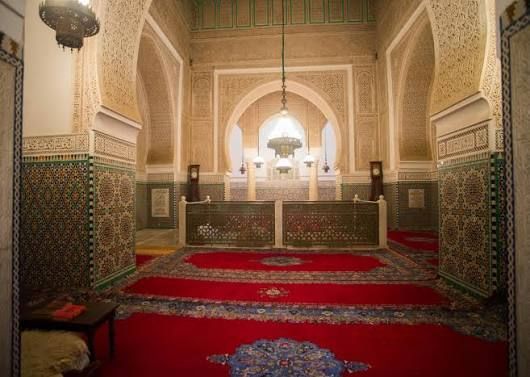
Before entering the inner sanctuary, you must remove your shoes. Stepping onto the cool tile, you enter a soaring patio filled with intricate geometrical zellige tilework, delicate carved cedar ceilings, and lace-like stucco panels.
4. The Tomb Chamber and the French Clocks
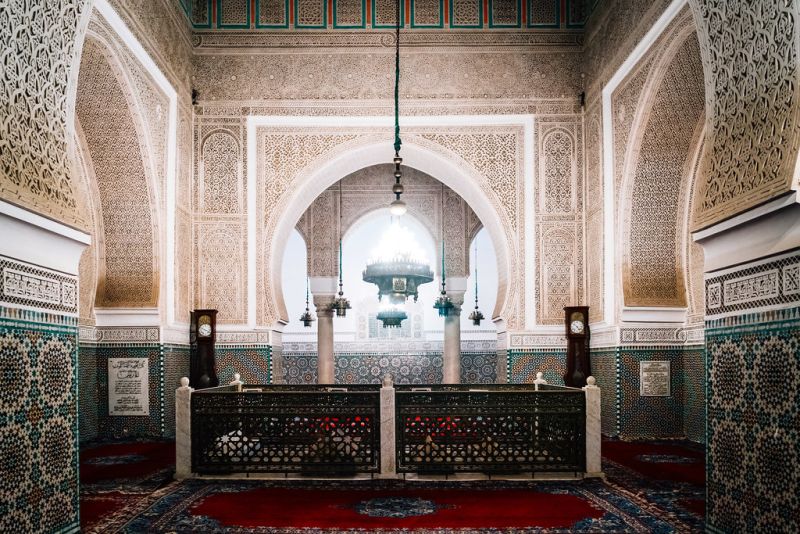
While non-Muslims cannot step directly up to the physical graves, you can stand at the threshold of the tomb chamber to look inside. Resting beneath horseshoe arches decorated with gold and deep greens lie the tombs.
Notice the four large grandfather clocks standing around the tomb. These were personal gifts sent to Moulay Ismail by King Louis XIV of France. Ismail had formally asked for the hand of Louis XIV's daughter, Princesse de Conti, in marriage. Louis XIV politely declined the marriage proposal but sent the elaborate French clocks as a diplomatic consolation prize. They still stand beside the Sultan’s grave centuries later.
Discover the Mausoleum of Moulay Ismail on one of our Morocco Tour Package and experience Morocco's rich history and culture.
Essential Visitor Information
Entry Fees
-
Standard Ticket: Free entry.
-
Donations: It is customary to leave a small tip/donation (10 to 20 Moroccan Dirhams, roughly $1–$2 USD) to the attendants at the shoe station or entrance gate.
Opening Hours
-
Saturday – Thursday: 9:00 AM – 6:30 PM.
-
Fridays: Hours vary due to Friday congregational prayers (Jumu'ah). The complex is often closed to tourists during midday Friday prayers (approx. 12:00 PM – 3:00 PM) or closed all day for religious services.
Dress Code & Etiquette
Because this is an active religious shrine (Zaouia), respectful attire is strictly required for all visitors:
-
For Men: Shoulders and knees must be covered (long trousers preferred over shorts).
-
For Women: Shoulders, chest, and knees must be covered. A headscarf is generally not mandatory for non-Muslim women in the tourist areas, but carrying one to cover exposed shoulders is recommended out of respect.
-
Shoes: You will be required to remove your shoes before stepping onto the carpeted and tiled areas of the inner sanctua
Step-by-Step Walking Route
-
Start at Place El-Hedim: Begin your morning in the main square of Meknes (the city's smaller answer to Marrakech's Jemaa el-Fnaa).
-
Marvel at Bab Mansour: Admire the grandest gate in North Africa, commissioned by Moulay Ismail and finished by his son in 1732.
-
Walk to the Mausoleum: Head through the imperial archways past the royal palace grounds; the mausoleum is a quick 5-minute walk from the gate.
-
Koubba el-Khayatine & Habs Qara: Right nearby, visit the Ambassador's Hall and the vast underground vaults believed to have served as a prison for European captives.
-
Heri es-Souani & Royal Stables: Walk south toward the granaries and the massive Aguedal Basin, built to feed and water Ismail’s 12,000 royal horses.
Real Visitor Insights & Honest Takes
To set realistic expectations, here is what recent travelers consistently note about their visit:
-
The Spatial Paradox: Many visitors expect a massive, sprawling complex like the Taj Mahal. In reality, the tomb area open to the public is relatively compact. The magic is in the tranquility and detail, not raw size.
-
Renovation Status: Meknes has been undergoing a massive, multi-year UNESCO restoration project across its imperial monuments. While the mausoleum reopens periodically between restoration phases, parts of adjacent structures or courtyards may occasionally have scaffolding.
-
A Sanctuary from the Medina: Travelers repeatedly highlight the mausoleum as a welcome break from the persistent shopkeepers and noise of the surrounding souks. It is cool, airy, and quiet.
-
Keep Small Change Handy: Keep a few 5dh or 10dh coins in your pocket for the shoe attendants or entry caretakers.
-
Photography Rules: Photography is permitted, but turn off your flash completely when entering the interior patio and tomb viewing area. Do not photograph local worshippers praying inside the sanctuary.
-
Best Lighting for Photos: Visit mid-morning (between 9:30 AM and 11:00 AM) when light filters vertically through the open patio roofs, illuminating the zellige tiles without harsh glare.
Frequently Asked Questions (FAQ)
1. Are non-Muslims allowed inside the Mausoleum of Moulay Ismail?
Yes. It is one of the few active religious sites in Morocco that permits non-Muslim visitors to enter the complex and view the royal tomb from the threshold.
2. How much does it cost to enter?
Admission is officially free, though leaving a small tip/donation of 10–20 MAD ($1–$2 USD) to the caretakers is recommended.
3. How long do I need for a visit?
Most travelers spend 30 to 45 minutes exploring the courtyards, admiring the tilework, and taking photos.
4. Is the mausoleum wheelchair accessible?
The ground-level courtyards are flat and paved, but there are small raised stone thresholds between doorways and steps leading into the inner sanctuary where shoes are removed.
5. What is the best time of year to visit Meknes?
Spring (March to May) and Autumn (September to November) offer the best weather, avoiding the severe summer heat of inland Morocco. If you wish to explore more about best maroccon trips, timing your travel during these shoulder seasons makes touring the Imperial Cities much more comfortable.
Step into Meknes to experience the breathtaking architecture and quiet majesty of Moulay Ismail’s Mausoleum. As one of Morocco’s rare holy sites welcoming non-Muslim visitors, it offers an unforgettable glimpse into rich imperial history and exquisite Moorish craftsmanship. Plan your journey today and discover this truly extraordinary Moroccan cultural treasure trough Morocco Holiday Packages.
Conclusion
The Mausoleum of Moulay Ismail stands as a breathtaking testament to imperial Moroccan architecture and royal heritage. As one of the few active religious sites open to non-Muslim visitors, its intricate tilework, serene courtyards, and rich history make it an unmissable highlight for anyone exploring Meknes. Incorporating this historical masterpiece into your Morocco Holiday Packages offers an unforgettable glimpse into the country's fascinating past and timeless craftsmanship.