
Bab Mansour: The Crown Jewel of Meknes Architecture
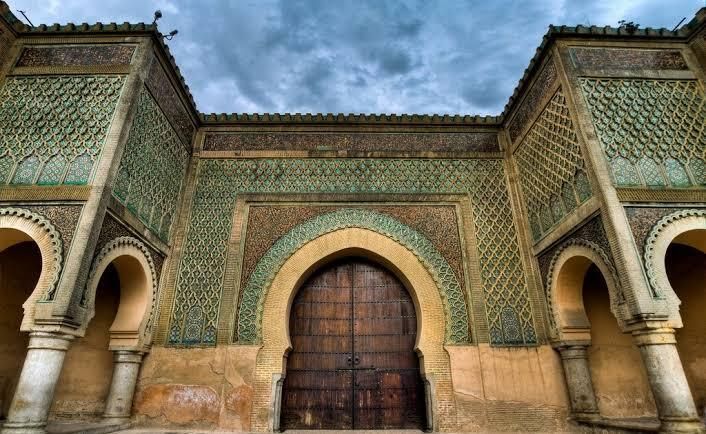
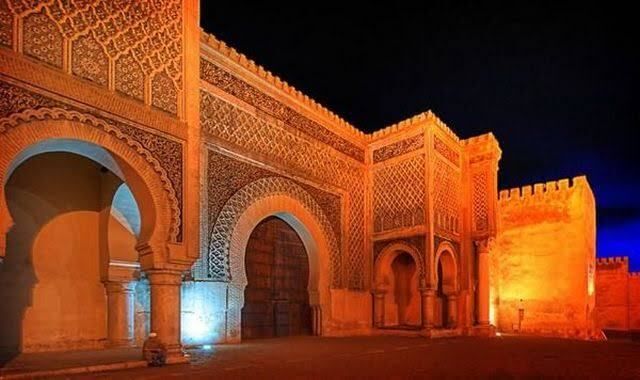
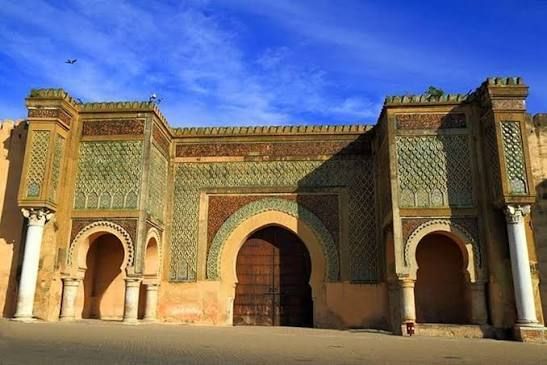
Standing proudly at the intersection between the old Medina and the imperial city of Meknes, Bab Mansour (officially Bab Mansour L’Alej) is widely regarded as one of the most magnificent monumental gateways in North Africa and a prime masterwork of Moroccan Islamic architecture. Commissioned by the legendary Sultan Moulay Ismail in the late 17th century and completed under his son, Sultan Moulay Abdallah, in 1732, this 16-meter-high grand entrance stands as an enduring monument to the ambition of the Alaouite dynasty. Facing the bustling expanse of Place El Hedim, the gate dominates the cityscape with its soaring horseshoe arch, intricate zellige tilework, and colossal marble columns salvaged from the nearby ancient Roman ruins of Volubili
Historical Context & Architectural Splendor
To understand Bab Mansour, one must understand Sultan Moulay Ismail, who ruled Morocco from 1672 to 1727. Seeking to transform Meknes into an imperial capital that could rival the grand court of Louis XIV in Versailles, the Sultan ordered the construction of massive stone ramparts, grand palaces, sprawling stables, and ceremonial gates. Bab Mansour was designed to be the principal ceremonial portal into his royal kasbah (citadel).
The architectural features that make Bab Mansour a masterwork include:
-
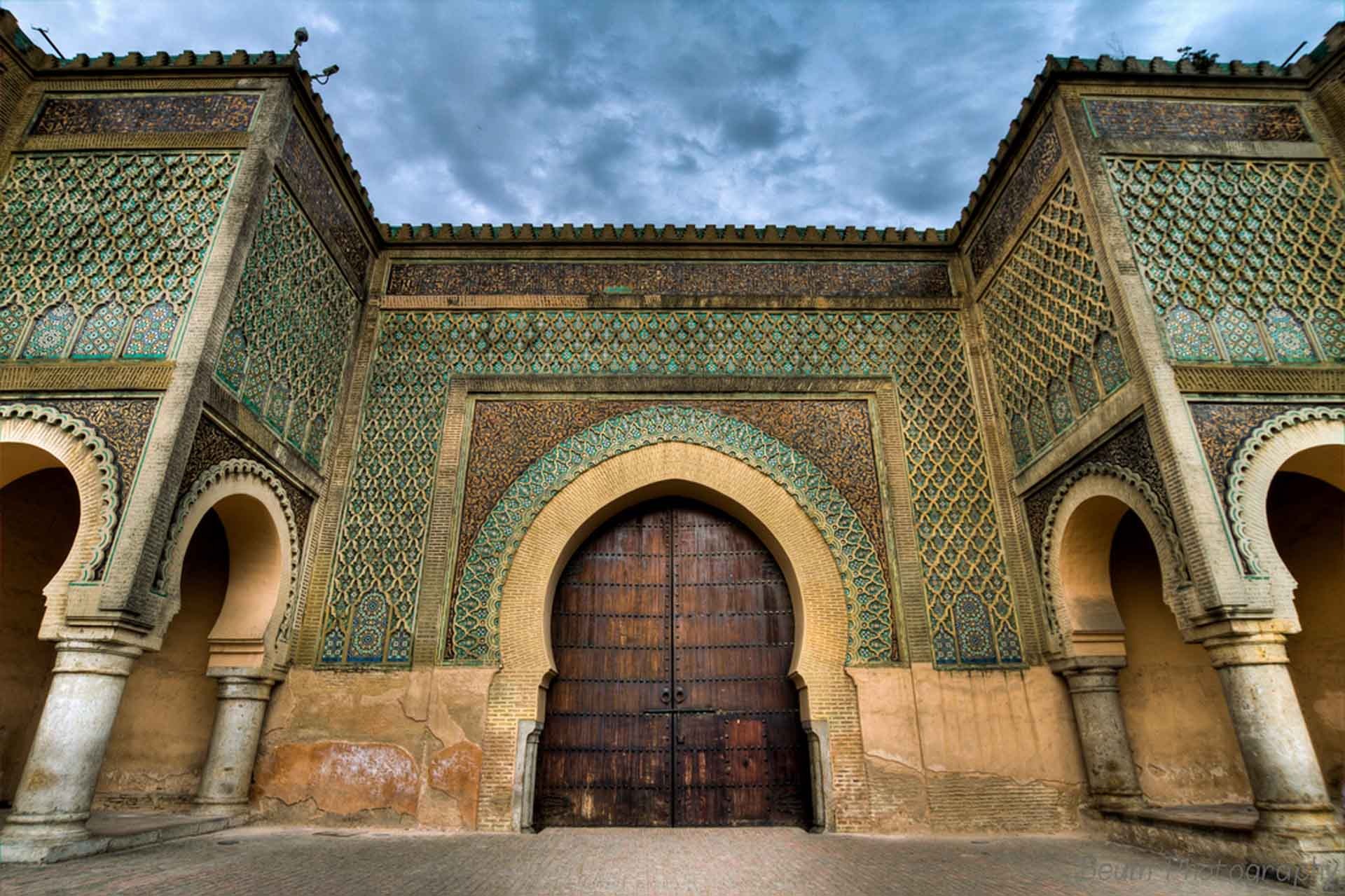
Zellij Tilework & Geometric Patterns: The facade is draped in a dense, lacelike tapestry of turquoise, green, and cobalt-blue ceramic tiles (zellij). The predominant green shades symbolize the city of Meknes and the Islamic faith.
-
The Antiquity Columns: Flanking the central portal are two grand white marble columns topped with intricate capitals. These ancient relics were retrieved from the nearby Roman city of Volubilis, bridging nearly two millennia of Moroccan history in a single structure.
-
Calligraphic Inscription: Running across the top band of the gate is an Arabic poetic inscription written in elegant black calligraphy. Spoken in the first person, it boasts: "I am the most beautiful gate in Morocco. I am like the full moon in the sky..."
-
The Architect's Legend: The gate derives its name from its principal architect, Mansour L'Alej ("Mansour the Renegade"), a Christian convert to Islam who rose in the Sultan's court. Local folklore holds that when the gate was completed, Sultan Moulay Ismail asked Mansour if he could have built it even better. When Mansour answered "Yes," the Sultan was allegedly so angered by the implication that the gate was imperfect that he had him executed. Historians consider this a mythical tale, as the gate was finished after the Sultan’s death, but it adds a layer of intrigue to the landmark.
Must-See Attractions Surrounding Bab Mansour
When visiting Bab Mansour, you are positioned at the heart of historic Meknes. The area immediately around the gate contains several major attractions:
Step through the magnificent Bab Mansour and uncover centuries of Moroccan history. Explore this breathtaking landmark as part of our Morocco Holiday Packages
and create unforgettable memories in Morocco!
1. Place El Hedim
Located directly opposite Bab Mansour, this expansive public square is the cultural hub of Meknes. Often described as a relaxed cousin to Marrakech's Jemaa el-Fnaa, Place El Hedim comes alive in the late afternoon and evening with street performers, storytellers, musicians, henna artists, and outdoor cafe seating.
2. The Imperial City Ramparts & Bab Jami'a
Spanning over 40 kilometers, the monumental walls surrounding the Imperial City offer a striking look at 18th-century military fortifications. While the main wooden doors of Bab Mansour remain closed for preservation, visitors pass through the adjacent smaller gateway (Bab Jami'a) to enter the inner complex.
3. Mausoleum of Moulay Ismail
A short walk through the royal quarter leads to the resting place of Sultan Moulay Ismail. It stands as one of the few active religious shrines in Morocco open to non-Muslim visitors, featuring peaceful courtyard fountains and pristine Moorish plasterwork and tile patterns.
4. Heri es-Souani & Sahrij Swani
Located slightly southeast of Bab Mansour, this engineering complex housed the royal granaries and vast underground stables capable of accommodating up to 12,000 horses. Next to it lies the Sahrij Swani, a massive man-made water reservoir constructed to irrigate the royal gardens and sustain the imperial city during droughts.
Why You Should Visit Bab Mansour
-
Unmatched Architectural Artistry: It is universally acclaimed as one of the finest architectural gates in the Islamic world. The blend of Roman marble, Almohad geometric proportions, and late Alaouite tile craft provides an authentic visual history of North Africa.
-
A More Authentic, Uncrowded Experience: Unlike the heavily commercialized tourist centers of Marrakech or Fes, Meknes offers an easygoing, relaxed atmosphere. You can take in the history without aggressive sales pitches or dense tour groups.
-
Gateway to a UNESCO World Heritage Site: The historic Medina and Imperial City of Meknes were designated a UNESCO World Heritage Site in 1996, with Bab Mansour serving as its signature visual emblem.
-
Photographer's Paradise: The contrast between the monumental golden stone, deep blue and green tiles, and the changing light throughout the day makes Bab Mansour an iconic photography location.
Essential Travel Advice for Visitors
-
Best Time of Day: Early morning (between 8:00 AM and 10:00 AM) provides soft, directional light on the facade, ideal for photography with virtually no crowds. Dusk is equally compelling, as the square fills with local energy and warm lighting illuminates the gate's details.
-
Best Season: Spring (March to May) and Autumn (September to November) offer comfortable temperatures ranging between 20°C and 28°C. Mid-summer temperatures often exceed 35°C–40°C.
-
Dress Code: As with all historical and cultural landmarks in Morocco, modest attire (covering shoulders and knees) is respectful and appreciated by locals.
-
Resting & People-Watching: Take advantage of the terraced cafes along the edge of Place El Hedim. Ordering a fresh Moroccan mint tea on an elevated balcony provides an unobstructed perspective of Bab Mansour and the square below.
Guest Experience Overview
Visiting Bab Mansour is an immersive sensory transition. Arriving at Place El Hedim, travelers are greeted by the hum of daily city life—the scent of fresh spices and roasted nuts from market stalls mixing with the calls of street vendors.
Standing in front of the gate itself, the sheer scale of the structure takes center stage. Looking closely reveals that the complex geometric patterns carved into the plaster are not uniform; they reflect hand-carved craftsmanship, where no two sections are identical. Passing through the smaller side portal shifts the environment instantly from the sunlit open square to the shaded, atmospheric maze of the old Medina's souks.
Frequently Asked Questions (FAQ)
| Question | Answer |
| Is there an entrance fee for Bab Mansour? | No. Bab Mansour is an outdoor monument located on a public square. It is completely free to view and take photographs 24/7. |
| Can you go inside or walk through the main gate? | The grand 52-foot central wooden doors are kept closed for structural preservation. Visitors enter the adjacent royal quarters or Medina via smaller side portals built into the bastion walls. The interior hall occasionally hosts local art exhibits. |
| How do I get to Bab Mansour from the train station? | From the Meknes Ville train station, a "Petit Taxi" (colored blue in Meknes) takes roughly 10 minutes to reach Place El Hedim / Bab Mansour and costs around 10–15 Moroccan Dirhams (MAD). |
| How much time should I allocate for a visit? | Plan for 1 to 2 hours to admire the gate, photograph the details, enjoy a mint tea at a nearby cafe, and walk across Place El Hedim. |
| Can Bab Mansour be visited alongside Volubilis? | Yes. Volubilis is located just 30 kilometers (about a 45-minute drive) north of Meknes. Travelers frequently pair a morning visit to the Roman ruins of Volubilis with an afternoon exploration of Bab Mansour and the Meknes Medina. |
Bab Mansour isn't just a historic gate; it's a gateway to Morocco's rich heritage and fascinating past. Discover this architectural masterpiece with our Morocco Private Tours and plan your visit today to experience its breathtaking grandeur firsthand!