
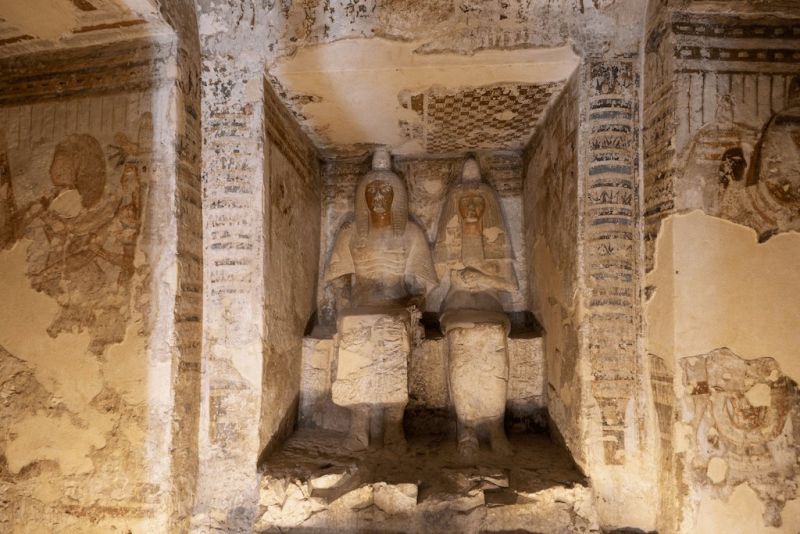
The Tombs of the Nobles is a designation for a broad collection of non-royal, rock-cut burial sites in ancient Egypt, carved into cliffs and hillsides primarily on the west banks of the Nile. These tombs were built for high-ranking officials, nobles, priests, scribes, and governors, rather than for pharaohs. While royal tombs—such as those in the Valley of the Kings—are among the most famous, the Tombs of the Nobles provide a complementary and richly detailed window into the lives, religious beliefs, and administrative structures of ancient Egypt. Their wall paintings and inscriptions often depict everyday scenes, bureaucratic duties, and deeply personal expressions of piety.
These necropolises are spread across several regions, notably in Luxor (ancient Thebes) and Aswan (Qubbet el-Hawa), and span a wide chronological range, from the Old Kingdom well into later dynasties.
Geographic Location and Layout
Luxor / Thebes (West Bank)
In Luxor, the Tombs of the Nobles are found in several necropolis zones along the western escarpment of the Nile, opposite the ancient city of Thebes. According to archaeological and tourist sources, there are more than 400 tombs in this area.
Key sub-regions include:
-
Sheikh Abd el‑Qurna: One of the most prominent areas, containing well-preserved New Kingdom tombs.
-
El-Khokha: A hill with tombs from various periods, including some Old Kingdom and New Kingdom burials.
-
El-Assasif: Later-period tombs, including those from the 25th and 26th Dynasties.
-
Dra Abu el-Naga: A hillside necropolis with tombs belonging to officials, priests, and other non-royal elite, especially prominent during the New Kingdom
-
El-Tarif: One of the older necropolis zones, with mastaba‑style tombs and row tombs from the Middle Kingdom and other periods.
Because of the scattered nature of these tombs, visitor access is often organized by “groups” of tombs, each requiring its own ticket from the Antiquities Inspectorate.
Aswan – Qubbet el‑Hawa
On the west bank of the Nile, opposite Aswan, lies another significant necropolis of nobles in Qubbet el-Hawa (“Dome of the Wind
These tombs date predominantly to the Old Kingdom and Middle Kingdom periods. The cliff face is terraced, and tombs are arranged on multiple levels. Access is via stairways carved into the rock, and many of the tombs have a similar basic plan: entrance hall → pillared chamber → corridor leading to the burial chamber.
A notable feature above the necropolis is the small domed tomb (church) of a local sheikh, giving the site its “dome” name.
Historical and Cultural Context
Who Were the “Nobles”?
In ancient Egypt, “nobles” in this context refers to non-royal but elite individuals: high officials, governors, stewards, scribes, priests, and regional administrators. Unlike kings or pharaohs, these people did not rule in the same way, but they wielded significant local power, were deeply engaged in the bureaucracy, and held religious offices or military responsibilities.
Their tombs reflect their status: while not as monumental as royal funerary complexes, they are nonetheless architecturally sophisticated and richly decorated. Moreover, because these tombs reflect the lives of the bureaucratic and administrative class rather than the royal family, they are invaluable for historians seeking insight into the functioning of the Egyptian state, local governance, and daily life.
Time Periods Covered
-
Luxor / Thebes: The tombs here span a very long period — from as early as the Old Kingdom, through the Middle Kingdom, and especially flourishing in the New Kingdom (c. 1550–1070 BCE), with some tombs used up to later dynasties (Late Period, Ptolemaic).
-
Aswan / Qubbet el-Hawa: Many tombs date from the Old Kingdom, through the Middle Kingdom, and a few later.
Function and Significance
-
Administrative Power: Many tomb owners held titles like “governor,” “overseer of the garrison,” “keeper of the gate,” or “scribe.” Their tomb inscriptions often list their official roles, family members, and achievements.
-
Religious Role: Several tombs show the interplay between secular and religious authority. For instance, Sarenput II (in Aswan) served as a priest of Khnum, and his tomb includes statues and painted scenes.
-
Cultural Record: Unlike royal tombs, whose wall texts can be more formulaic and focused on royal ideology, the tombs of the nobles frequently include scenes from daily life — banquets, agriculture, fishing, trading, administrative duties — giving us a more grounded and human portrait of ancient Egyptian society.
-
Architectural Diversity: The structures vary: some are simple rock-cut chapels, while others have pillared rooms, niches with statues, and detailed tomb plans.
Key Tombs and Notable Examples
Here are some of the most important and illustrative Tombs of the Nobles:
In Luxor / Thebes
-
TT52 — Nakht: Nakht was a scribe and astronomer associated with the temple of Amun during the New Kingdom. His tomb is famed for its colorful wall paintings showing banquets, musicians, agricultural scenes, and rural life.
-
TT55 — Ramose: Ramose served as a vizier and governor during the reigns of Amenhotep III and Akhenaten. His tomb is especially notable because its decoration reflects a transition between classical New Kingdom art and the early Amarna style: one wall shows traditional reliefs, while another uses more fluid, sun-inspired Amarna motifs.
-
TT57 — Khaemhat (Mahu): Khaemhat was an important scribe and overseer of the granaries under Amenhotep III. His tomb’s reliefs are celebrated for their rich quality and as high examples of New Kingdom non-royal art.
-
TT60 — Senet (Antefoqer): This tomb belongs to a woman named Senet, who was related to the vizier Intefiqer. The layout includes a long corridor and deep niche, and scenes show her in front of offering tables as well as Intefiqer engaged in hunting.
-
TT100 — Rekhmire: Rekhmire was a vizier under Thutmose III and Amenhotep II. His tomb contains detailed scenes of tribute from foreign lands — Nubians, Syrians, and Aegean envoys — offering gifts, plus depictions of his administrative role and complex judiciary duties.
-
TT69 — Menna: Menna’s tomb includes lush representations of agricultural life — sowing, harvesting, animal husbandry — as well as banquet scenes. (Listed in sources of notable tombs.)
-
TT96 — Sennefer: Known for its “grapevine ceiling,” this tomb belongs to one of Thebes’ mayors and is addressed in tourist guides.
-
TT29 — Amenemopet (Pairy): A vizier buried in Sheikh Abd el‑Qurna, with scenes in his tomb of him making offerings, passing judgment, and detailed texts about his role.
-
TT139 — Pairy / Pairi (wab-priest of Amun): Located in Sheikh Abd el‑Qurna. He held priestly and administrative roles under Amenhotep III.
These are just a sampling — there are many more tombs in the necropolis, each with its own story and art.
In Aswan – Qubbet el‑Hawa
-
Tomb QH31 — Sarenput II: Perhaps the most famous of these. Sarenput II was a governor and overseer of priests under Amenemhat II (12th Dynasty). His tomb is well preserved: the entrance chamber has six carved pillars, a hallway with niches that once held statues, and a burial chamber with painted scenes of him with his wife and mother, and fishing or hunting motifs.
-
Tomb QH36 — Sarenput I: This earlier tomb, also rock-cut, has sunk-relief decoration externally, with painted interior. Sarenput I held important titles in his lifetime.
-
Tomb of Harkhuf (QH25/26): Harkhuf was a major figure under the Sixth Dynasty (Pepi I/II) who led expeditions into Nubia. His tomb contains texts and reliefs relating to his journeys, military campaigns, and diplomatic activities.
-
Tomb of Pepinakht (Heqaib): Another noble with a tomb in Qubbet el‑Hawa, with historical significance for his military role and regional influence.
Artistic, Religious, and Social Significance
Daily Life and Bureaucracy
One of the most compelling features of the Tombs of the Nobles is how richly they depict everyday life: agricultural labor, crafting, banquets, preparing offerings, bureaucratic duties, and family moments. These show us more than royal ideology — they offer a ground-level view of ancient Egyptian society.
For example, scenes in some tombs show records of tribute, trade, or foreign delegations, which highlight Egypt’s economic and diplomatic reach. In others, depictions of farming or granaries reflect the vital importance of food production and resource management.
Funerary and Religious Beliefs
Although the tombs are non-royal, their design and decoration reflect key Egyptian funerary ideas:
-
Plans & Layouts: Many tombs follow a recognizable typology — an entrance hall, a pillared chamber, a corridor, then the burial chamber. This spatial progression echoes the journey to the afterlife.
-
Statues and Niches: Some tombs have niches with statues of the deceased in an Osirian or mummiform form, associating them with the god Osiris and the afterlife. Sarenput II’s tomb, for instance, had niches holding statues.
-
Biographical Texts: Tomb inscriptions often include biographical texts, titles, and achievements. These texts were not just commemorative but also served a ritual purpose, emphasizing the person’s piety, status, and connection to divine powers.
-
Offerings and Rituals: Scenes show the deceased receiving offerings, family members participating in rituals, and priests performing funerary ceremonies. These strongly emphasize the continued relationship between the living and the dead.
Art and Symbolism
The decorative program of these tombs is a rich tapestry:
-
Color and Technique: In well-preserved tombs (for example, Sarenput II), the pigments remain vivid. The use of bright colors, careful proportion, and hieroglyphic inscriptions demonstrates high artistic quality.
-
Symbolic motifs: Hunting, fishing, banquets, and agricultural scenes are not just decorative; they carry symbolic weight, emphasizing fertility, abundance, regeneration, and the ideal of an eternal afterlife reflecting earthly prosperity.
-
Political and Diplomatic Themes: In tombs like Rekhmire’s, tribute scenes with foreign envoys are prominent — a reminder of Egypt’s relationships and power beyond its borders.
-
Artistic Transitions: Tombs like Ramose’s (TT55) capture a moment of artistic and religious transition: the blending of traditional New Kingdom style with early Amarna (Aten-centered) art.
Archaeology, Discovery, and Conservation
Excavation History
-
The Tombs of the Nobles in Luxor have been studied by Egyptologists for over a century. Many tombs were documented in the 19th and early 20th centuries by early travelers, but systematic archaeological work has continued into modern times.
-
In Aswan (Qubbet el-Hawa), excavations have revealed tombs dating back to the Old Kingdom and Middle Kingdom, including important finds like the biographical inscriptions of Sarenput I and II.
-
New discoveries continue: according to Lonely Planet, several decorated tombs were still being uncovered as recently as 2014 and 2017.
-
Even in 2025, archaeologists announced the discovery of three tombs in the Dra Abu el-Naga necropolis (Luxor) belonging to high-ranking statesmen, showing that this is still an active and fruitful field.
Preservation Challenges
-
Exposure and Weathering: Many tombs are rock-cut and exposed to the elements, which over millennia has caused erosion, fading of pigments, and damage to reliefs.
-
Tourism Pressures: Increased visitor traffic demands careful management. Tombs are grouped and ticketed to regulate access.
-
Conservation Efforts: Archaeologists, in collaboration with Egyptian antiquities authorities, work to stabilize wall paintings, restore structural elements, and document inscriptions. However, preserving color and delicate reliefs remains a complex task.
Significance for Modern Scholarship and Tourism
Historical Insight
The Tombs of the Nobles are a treasure trove for Egyptologists and historians:
-
They reveal the administrative structure of ancient Egypt: who governed, who served, and how power was distributed.
-
The biographical inscriptions help reconstruct genealogies, career paths, and local governance.
-
The daily-life imagery informs us about agriculture, economy, social practices, and religion in non-royal contexts—not only in myth and ritual, but in lived experience.
Cultural Tourism
For visitors, these tombs offer:
-
A more intimate and accessible alternative to royal tombs: many are less crowded, deeply human in their content, and richly decorated.
-
A diversity of experience: from large, monumental tombs with statues to small chapels with vivid daily scenes.
-
A window into the transitions of Egyptian art and religion (e.g., tombs like Ramose’s show both traditional and Amarna-style art).
The ticketing system, which groups tombs for visitors, allows for structured exploration while helping protect fragile sites.
Selected Tombs: Short Profiles
Here are a few more detailed snapshots of specific tombs:
-
Sarenput II (QH31, Aswan)
-
Role: Governor, Garrison Commander, Priest of Khnum.
-
Layout: Six-pillared entrance chamber, hallway with niches, burial chamber with four pillars.
-
Decoration: Statues, paintings of family, hunting, fishing, and a detailed biographical inscription.
-
-
Harkhuf (QH25/26, Aswan)
-
Role: Overseer of foreign troops under Pepi I and Pepi II (6th Dynasty).
-
Notable for: His tomb’s texts that relate his expeditions into Nubia, his military and diplomatic achievements, and the letter he received from Pharaoh Pepi II.
-
-
Nakht (TT52, Luxor)
-
Role: Scribe and astronomer of the temple of Amun.
-
Artistic features: Banquet scenes, musicians, dancers, agriculture, offering bearers, false doors.
-
Significance: Provides a beautifully intimate look at non-royal elite life, mixing piety, work, and family.
-
-
Ramose (TT55, Luxor)
-
Role: Vizier and governor during Amenhotep III and Akhenaten.
-
Unique Aspects: Transitional artistic style; early Amarna influence; scenes of the royal family worshipping Aten.
-
-
Khaemhat (TT57, Luxor)
-
Role: Royal scribe and overseer of granaries under Amenhotep III.
-
Artistry: Highly praised reliefs, detailed carvings, elegance of design, typical New Kingdom elite tomb style.
-
-
Senet / Antefoqer (TT60, Luxor)
-
Role: Related to Vizier Intefiqer (possibly his wife or mother).
-
Tomb Structure: Corridor, niche, burial chamber. Scenes of offering, hunting, and depiction of the vizier.
-
Legacy and Interpretation
The Tombs of the Nobles continue to be deeply important for both academic research and public heritage. They:
-
Democratize history: While Pharaohs get most of the attention, these tombs document the lives of powerful but non-royal individuals, giving a fuller, more layered understanding of ancient Egyptian society.
-
Reflect changing beliefs: Through time, shifts in religious outlook (for example, the rise of Atenism) are reflected in tomb art (e.g., Ramose’s TT55).
-
Inspire modern visitors: These tombs are more than archaeological relics; they are a vivid, artistic expression of life, death, and memory. They help modern people connect emotionally and intellectually with ancient Egypt.
Conclusion
The Tombs of the Nobles are a vital part of Egypt’s funerary landscape. They complement royal burials by offering a more personal, administrative, human perspective on ancient Egypt. Whether in Luxor, with its clusters of New Kingdom tombs, or in Aswan’s Qubbet el-Hawa, with its cliff-side terraces and painted chambers, these necropolises tell stories of public service, faith, family, diplomacy, and the everyday realities of elite life in antiquity.
They remain a focal point for archaeological discovery, scholarly interpretation, and cultural tourism — revealing how the elite of ancient Egypt envisioned their afterlife, preserved their memory, and expressed their values through art, architecture, and inscription