
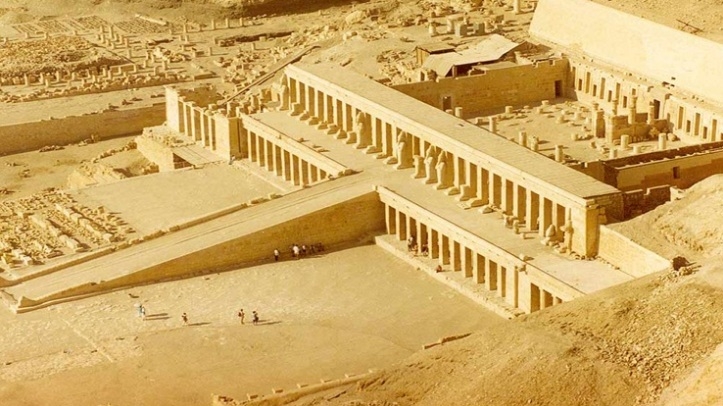
Temple of Mentuhotep | Mortuary Temple of Mentuhotep
Hidden in the rugged cliffs of Deir el-Bahari on the west bank of the Nile in Luxor, the Temple of Mentuhotep II stands as a silent monument to rebirth — both divine and political. This extraordinary structure, known as the Mortuary Temple of Mentuhotep, marks one of the most important architectural revolutions in ancient Egyptian history.
Built more than 4,000 years ago, this temple not only honored King Mentuhotep II, the unifier of Egypt and founder of the Middle Kingdom, but also redefined the sacred architecture of ancient Egypt. It served as a prototype for later masterpieces like the Temple of Hatshepsut and the grand mortuary temples of the New Kingdom.
The Temple of Mentuhotep is a story of renewal — the rebirth of a kingdom, a king, and the timeless bond between life, death, and eternity.
Historical Background: The King Who Reunited Egypt
Before the rise of Mentuhotep II, Egypt had been torn apart by a long period of political fragmentation known as the First Intermediate Period (2181–2055 BC). Rival dynasties ruled from Herakleopolis in the north and Thebes in the south, dividing the land once united under the pharaohs of the Old Kingdom.
Mentuhotep II, the 11th Dynasty ruler of Thebes, emerged as a strong and visionary leader. Through a series of military and political campaigns, he defeated the northern kings and reunified Egypt around 2055 BC, ushering in the Middle Kingdom — a golden era of stability, art, and architectural innovation.
To commemorate this monumental achievement and honor the gods who guided him, Mentuhotep ordered the construction of a grand mortuary temple in Deir el-Bahari, the sacred site west of Thebes that symbolized the land of the dead.
Location: The Sacred Cliffs of Deir el-Bahari
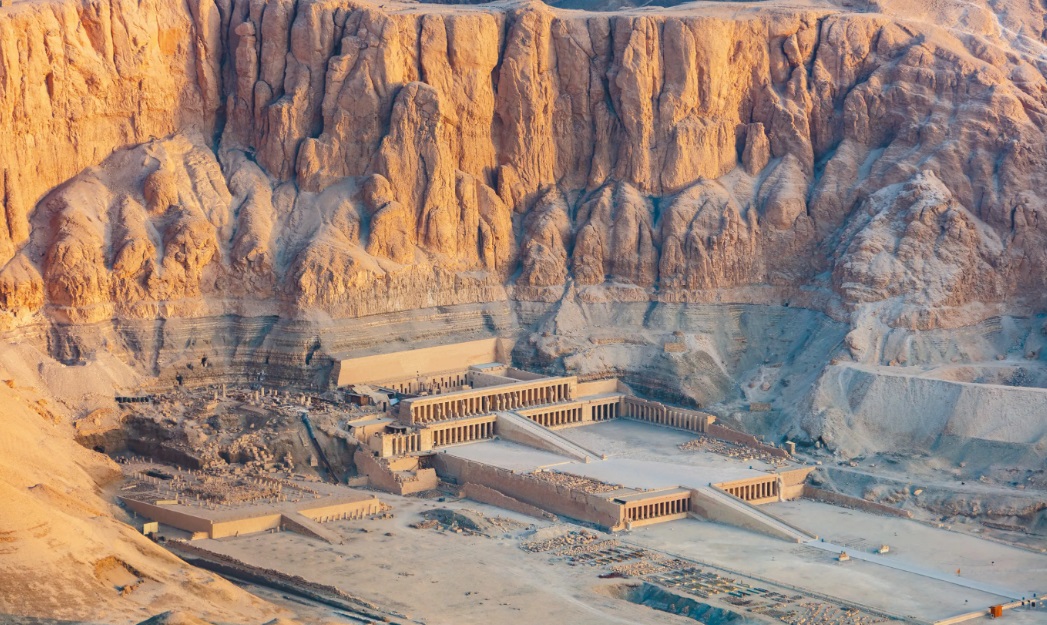
The choice of Deir el-Bahari was not accidental. Nestled beneath towering limestone cliffs, this site had long been considered sacred — a natural amphitheater facing the rising sun. It offered a perfect setting for a temple dedicated to divine resurrection.
The name Deir el-Bahari means “Monastery of the North,” given by later Coptic monks who settled in the ruins during the Christian era. But in Mentuhotep’s time, it was known as Djeser-Djeseru — “the Holy of Holies.”
Here, the temple was designed not just as a funerary monument but as a symbolic bridge between life and afterlife, where the pharaoh could eternally unite with the sun god Ra and the god of the dead, Osiris.
Architectural Innovation: A New Vision of the Afterlife
The Mortuary Temple of Mentuhotep was unlike anything built before it. Previous mortuary temples, such as those at Saqqara and Giza, followed a standard layout of causeways and pyramid complexes. Mentuhotep broke with tradition.
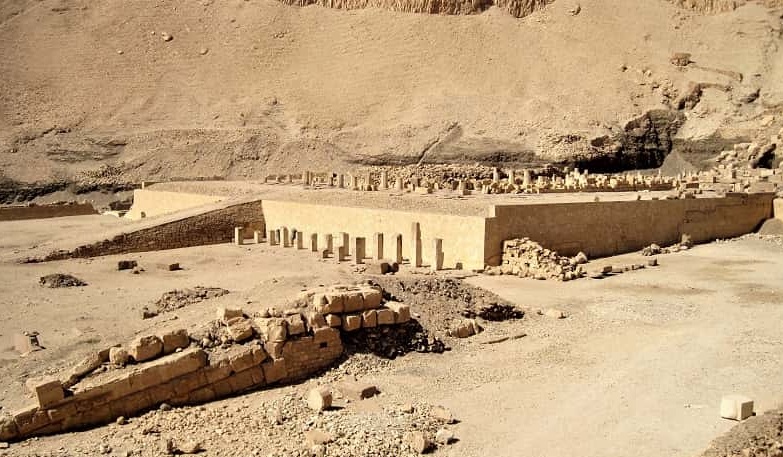
His temple introduced a terraced design, built into the cliffs themselves — a visionary concept that blended natural landscape and sacred architecture. This design would later inspire the nearby Temple of Hatshepsut, built 500 years later.
The Layout of the Temple
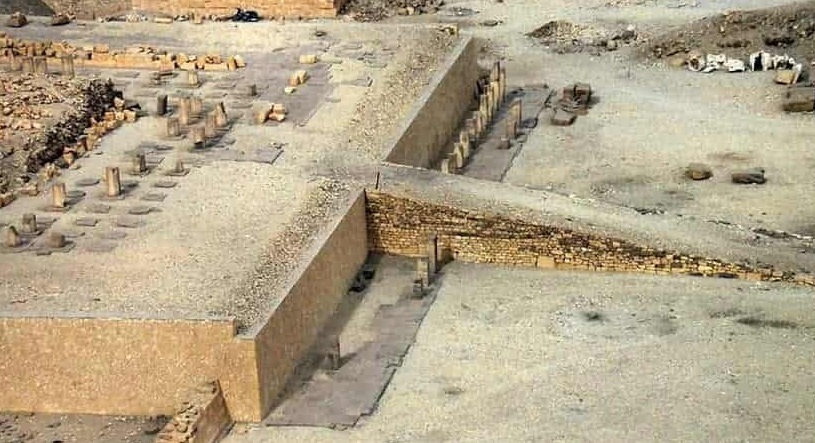
The structure was built on several ascending terraces, connected by ramps and colonnades, leading from the valley to the sanctuary cut into the cliff face.
The complex included:
-
A valley temple, now mostly destroyed, near the edge of the cultivation
-
A causeway leading to the main complex
-
An open forecourt, surrounded by chapels and statues
-
The main terrace, with colonnades of square pillars
-
The central core, possibly once topped by a pyramid or mound symbolizing resurrection
-
Inner chapels, shrines, and underground burial chambers for the king and royal family
The combination of pyramid symbolism and terraced architecture created a powerful visual and spiritual effect — a physical representation of the sun’s ascent and the king’s eternal rise to divinity.
The Central Core: Mystery of the Lost Pyramid
At the heart of the temple stood a mysterious central structure — once believed to be a solid pyramid, but more likely a mound-like sanctuary symbolizing the primeval hill of creation, the sacred spot where life first emerged according to Egyptian cosmology.
Archaeological excavations revealed a shaft descending deep underground beneath this structure, leading to the burial chamber of Mentuhotep II. Within this tomb, archaeologists found fragments of the king’s sarcophagus and traces of burial offerings, confirming that the temple served as both funerary monument and royal tomb.
This unique dual purpose set it apart from all other temples of its time and marked a turning point in Egyptian mortuary architecture.
Art and Decoration: The Dawn of a New Era
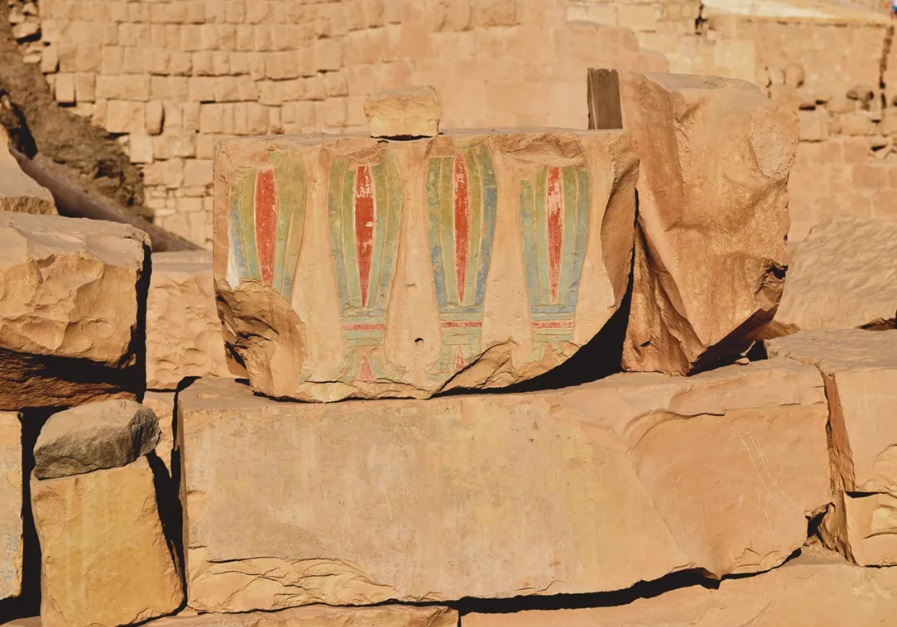
Although much of the temple’s decoration has faded with time, enough remains to reveal the refined artistry of the Middle Kingdom.
The walls were once covered with brightly painted reliefs depicting:
-
Scenes of the king’s divine birth and coronation
-
Ritual processions of priests carrying sacred barques
-
Offerings to Osiris, Anubis, and Hathor
-
Depictions of soldiers, dancers, and musicians celebrating the reunification of Egypt
In one striking discovery, archaeologists found painted wooden statues of kneeling women, possibly priestesses or royal concubines, placed around the king’s burial chamber. These statues symbolized attendants who would serve the pharaoh in the afterlife.
The artistic style of the reliefs bridges the Old and Middle Kingdoms — moving from rigid formality toward more natural, expressive human figures.
The Chapels and Tombs of the Royal Family
Surrounding the central sanctuary, several small tombs and chapels were built for royal family members and high-ranking officials. Excavations uncovered six tomb shafts belonging to royal women, possibly queens or princesses related to Mentuhotep II.
Within these tombs, archaeologists discovered:
-
Sarcophagi of fine limestone
-
Wooden coffins painted with hieroglyphic texts
-
Jewelry and funerary models representing daily life scenes
These discoveries offered an intimate glimpse into the royal court of the 11th Dynasty and the beliefs surrounding life after death.
One of the most remarkable finds was the mummy of Queen Kawit, one of Mentuhotep’s consorts, whose beautifully carved sarcophagus shows her being anointed by servants — a rare and delicate piece of early Middle Kingdom art.
Religious Meaning: Rebirth and Divine Union
The temple’s entire design reflects the Egyptian vision of life, death, and rebirth. The terraces represented the sun’s path from horizon to zenith; the ramps symbolized the pharaoh’s spiritual ascent; and the inner sanctuary embodied his eternal union with the gods.
Mentuhotep II identified himself with Osiris, the god of resurrection, and sought to ensure his rebirth in the afterlife through the rituals performed in the temple. Each year, priests would carry out sacred ceremonies reenacting the Osirian mysteries, celebrating the cycle of death and renewal.
This emphasis on resurrection, solar worship, and divine kingship would become the foundation of all later Egyptian mortuary temples.
Archaeological Discoveries and Excavations
The Temple of Mentuhotep has long fascinated archaeologists. It was first studied in the 19th century by explorers such as Édouard Naville and later excavated in depth by Herbert E. Winlock of the Metropolitan Museum of Art in the early 20th century.
Winlock’s excavations revealed many extraordinary finds, including:
-
The burial shaft of Mentuhotep II
-
Painted reliefs and fragments of statues
-
Mummified remains of royal family members and priests
-
Funerary models showing miniature boats, servants, and soldiers
One of the most dramatic discoveries was the Tomb of an Unknown Soldier, containing the remains of a warrior buried with honors, possibly one of the soldiers who helped reunify Egypt under Mentuhotep.
These discoveries not only deepened understanding of Mentuhotep’s reign but also shed light on the religious and artistic transition between the Old and Middle Kingdoms.
The Legacy of Mentuhotep’s Temple
The architectural genius of the Temple of Mentuhotep II changed the course of Egyptian temple design forever.
Five centuries later, Queen Hatshepsut chose to build her own mortuary temple just beside Mentuhotep’s — directly inspired by his terraced design. Her temple, though grander and more elaborate, clearly echoes the original concept pioneered by Mentuhotep.
Thus, Mentuhotep II not only reunited Egypt politically but also redefined its sacred architecture, bridging the old pyramid tradition and the grand temple complexes of the New Kingdom.
Visiting the Temple of Mentuhotep Today
Today, the Temple of Mentuhotep remains one of the highlights of the Deir el-Bahari complex in Luxor. Though weathered by time, its structure still conveys a powerful sense of symmetry, purpose, and peace.
???? Location:
Deir el-Bahari, West Bank of the Nile, Luxor, Egypt
???? Opening Hours:
Daily from 6:00 AM to 5:00 PM
???? Entrance Fees (as of 2025):
-
General Admission: 300 EGP
-
Student Ticket: 150 EGP
???? How to Get There:
From central Luxor, you can take a taxi, private car, or organized tour to the West Bank. The drive takes about 30 minutes. The temple is located next to the Temple of Hatshepsut, making it easy to visit both sites in a single trip.
???? Travel Tips:
-
Visit early morning or late afternoon for the best lighting.
-
Wear comfortable shoes — expect stairs and rocky terrain.
-
Bring water, sunscreen, and a hat; the site is open and sun-exposed.
-
Hire a local guide for expert insights into the temple’s symbolism.
-
Combine your visit with nearby sites like the Valley of the Kings, Temple of Hatshepsut, and Tombs of the Nobles.
Nearby Attractions
-
Temple of Hatshepsut: Just beside Mentuhotep’s temple, this magnificent structure is a must-see.
-
Valley of the Kings: The royal burial ground of the New Kingdom pharaohs, including Tutankhamun.
-
Colossi of Memnon: The giant seated statues of Amenhotep III guarding the Theban plain.
-
Ramesseum: The grand mortuary temple of Ramesses II, showcasing colossal statues and reliefs.
-
Deir el-Medina: The ancient village of the artisans who built the royal tombs.
Visiting Mentuhotep’s temple in the context of these sites offers a complete journey through Thebes’ sacred landscape.
Spiritual Atmosphere and Visitor Experience
Standing on the terraces of Mentuhotep’s temple, one can feel the sacred harmony between man-made structure and natural rock. The cliffs rise dramatically behind the temple like a natural pyramid, framing the site in divine geometry.
In the quiet morning air, as sunlight touches the limestone walls, you can imagine the ancient priests performing their hymns, incense rising toward the sky, and the pharaoh’s spirit ascending to join the gods.
Unlike the crowded temples of Karnak or Luxor, the Temple of Mentuhotep offers a peaceful, meditative experience, where visitors can truly connect with Egypt’s spiritual legacy.
Preservation and Modern Restoration
Ongoing archaeological and restoration efforts have helped preserve the temple’s unique layout. Teams from the Egyptian Ministry of Tourism and Antiquities continue to stabilize the terraces and restore the faded reliefs.
Conservation projects also include cleaning stone surfaces, strengthening retaining walls, and documenting inscriptions digitally to ensure long-term preservation.
Thanks to these efforts, visitors can still walk through the same pathways that ancient priests once used more than 4,000 years ago — an experience unmatched anywhere else in Egypt.
The Symbolism of Eternal Rebirth
The Mortuary Temple of Mentuhotep II embodies the eternal Egyptian belief in resurrection and divine kingship. The pharaoh, as the living Horus, dies and becomes Osiris, ruler of the underworld — only to be reborn again with the rising sun.
This concept of cyclical renewal is carved into every wall and built into every stone of the temple. Its terraces climb like steps toward heaven, symbolizing the king’s journey from death to immortality.
The temple’s design perfectly mirrors Egypt’s worldview — that death is not an end but a sacred passage into a higher state of existence.
Conclusion: The Eternal Temple of the Unifier King
The Temple of Mentuhotep at Deir el-Bahari is more than a monument; it is a declaration of unity, rebirth, and divine power.
Mentuhotep II restored order to a divided land and gave birth to a new era of Egyptian greatness. His temple — carved into the living rock and aligned with the sun — stands as a timeless reminder of that achievement.
Visiting this temple today is like walking through the dawn of Egyptian civilization’s rebirth — a journey into the moment when art, faith, and architecture merged to express the eternal cycle of life and afterlife.
Discover the Temple of Mentuhotep in Luxor — where Egypt was reborn, where kings became gods, and where stone itself tells the story of eternal resurrection.