
What Is a Dahabiya Nile Cruise? The Ultimate Guide to Egypt's Most Authentic Sailing Experience
A Traveler's First Experience on a Dahabiya
The first time I watched a dahabiya move quietly along the Nile, I understood that this was going to be a very different kind of Egypt experience.
There was no rush. The large sails caught the breeze, the river moved gently beside us, and the banks seemed to unfold like a living painting. Small villages appeared in the distance, green farmland lined the water, and ancient landscapes slowly changed as we sailed south.
I had already experienced the excitement of visiting Egypt's famous temples, but traveling by dahabiya gave me something completely different: time.
Instead of spending most of the journey inside a large cruise ship, I could sit on deck, watch the scenery, listen to the water, and enjoy the Nile at a much slower pace. We could also reach quieter places that are not always part of standard Nile cruise itineraries.
That was when I understood why travelers often describe a dahabiya as one of the most intimate ways to experience the Nile.
If you are wondering what a dahabiya Nile cruise is, how it differs from a conventional Nile cruise, what you can expect onboard, and whether it is suitable for your Egypt holiday, this guide covers everything you need to know.
What Is a Dahabiya Nile Cruise?
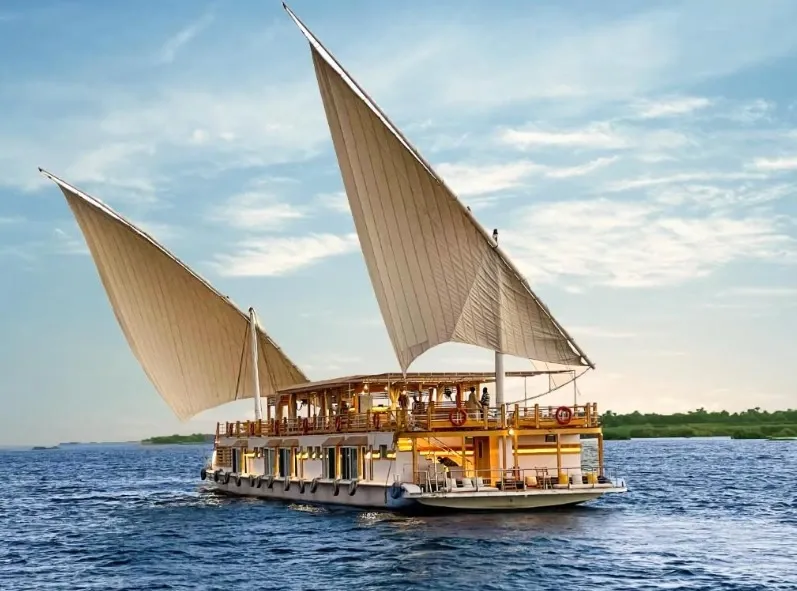
A dahabiya Nile cruise is a traditional-style sailing boat designed for cruising the Nile, usually between Luxor and Aswan.
Modern dahabiyas are inspired by the two-masted sailing vessels historically used on the Nile. Today's boats combine the appearance and peaceful sailing style of these traditional vessels with modern accommodation, dining, bathrooms, and other comforts.
According to Egypt's official tourism authority, dahabiyas are generally much smaller than conventional Nile cruise ships and are designed to provide a more intimate and exclusive experience. Their large sails can take advantage of the Nile's breeze, allowing for a quieter and slower journey.
The biggest difference is the atmosphere.
A large Nile cruise can carry many passengers and usually follows a set schedule. A dahabiya typically carries a much smaller number of guests, making the experience more private and relaxed.
Because these boats are smaller, they can also stop at villages, islands, and less-visited locations along the river that may not be accessible to larger cruise ships.
In simple terms, a dahabiya is not just transportation between Luxor and Aswan.
It is a slower way of experiencing the Nile itself.
Quick Facts About Dahabiya Nile Cruises
Before booking a dahabiya, here are the essential details to know.
Location
Most dahabiya itineraries operate along the Nile between Luxor and Aswan, with some itineraries operating in the opposite direction.
Opening Hours
A dahabiya is not an attraction with traditional opening hours. Sailing schedules depend on the specific boat, itinerary, weather, and river conditions.
Prices
Dahabiya prices vary considerably depending on the boat, cabin category, number of nights, travel season, inclusions, and whether you book a private or shared sailing experience.
Duration
Common journeys range from several nights to longer private itineraries. The exact duration depends on the route and boat.
Best Time to Visit
The official Egyptian tourism authority recommends October through May for Nile cruising, when daytime conditions are generally warm and sunny and evenings can bring cooler river breezes.
Best Route
The classic route is between Luxor and Aswan, allowing travelers to combine sailing with visits to some of Egypt's most important ancient sites.
Experience Level
A dahabiya is suitable for travelers who prefer relaxation, smaller groups, scenic sailing, cultural experiences, and a slower pace rather than a large-ship cruise atmosphere.
The History Behind the Dahabiya
Traditional Sailing on the Nile
The Nile has always been central to Egyptian life.
For thousands of years, boats were used for transportation, trade, agriculture, communication, and religious journeys. The river provided one of the most practical ways to travel through the Nile Valley.
Traditional sailing vessels used the river's wind and current to move between settlements and important destinations.
Dahabiyas became associated with elegant Nile travel and were particularly connected with travelers who wanted to explore Egypt in comfort.
The word is often associated with the Arabic term for gold, reflecting the luxurious reputation these vessels developed.
Over time, steam-powered boats and modern cruise vessels transformed Nile travel. Today, however, the dahabiya has returned as a distinctive way to experience the river.
Modern boats preserve the visual character and intimate scale of traditional dahabiyas while adding contemporary comforts.
Dahabiya vs. Traditional Nile Cruise
One of the most common questions travelers ask is:
What is the difference between a dahabiya and a regular Nile cruise?
The answer is mainly about size, pace, atmosphere, and flexibility.
Size
A conventional Nile cruise ship can accommodate a large number of passengers.
A dahabiya is considerably smaller.
This creates a quieter atmosphere and makes it easier to enjoy shared spaces without the feeling of being on a large floating resort.
Sailing Style
A dahabiya is designed around sailing.
Its large sails can capture the river breeze, creating a gentle movement along the Nile.
Large cruise ships rely primarily on engines.
The result is a noticeably different atmosphere.
Pace
A conventional Nile cruise usually follows a structured itinerary.
A dahabiya can offer a slower experience, with opportunities for additional stops depending on the specific boat and route.
Egypt's official tourism authority specifically highlights the ability of dahabiyas to stop at villages, islands, and lesser-known archaeological locations.
Privacy
Dahabiyas are particularly attractive to couples, families, small groups, and travelers celebrating special occasions.
Some can be chartered privately, while others operate with small groups.
Entertainment
Large cruises may offer larger entertainment programs, swimming pools, organized activities, and more extensive onboard facilities.
Dahabiyas are usually more focused on the river itself.
The entertainment is often the scenery, conversation, food, sunset, and peaceful rhythm of sailing.
What to Expect on a Dahabiya Nile Cruise
A Peaceful Sailing Experience
The first thing many travelers notice is the quiet.
Instead of hearing the constant activity associated with a large cruise ship, you may spend long periods listening to the breeze and water.
The Nile becomes part of the experience rather than simply the route between sightseeing stops.
Comfortable Accommodation
Modern dahabiyas vary in size and design, but many provide comfortable cabins or suites with private bathrooms and carefully designed interiors.
Some boats have elegant furnishings, spacious cabins, and private or semi-private outdoor areas.
Before booking, always check the exact cabin dimensions and facilities of your selected boat because standards vary between vessels.
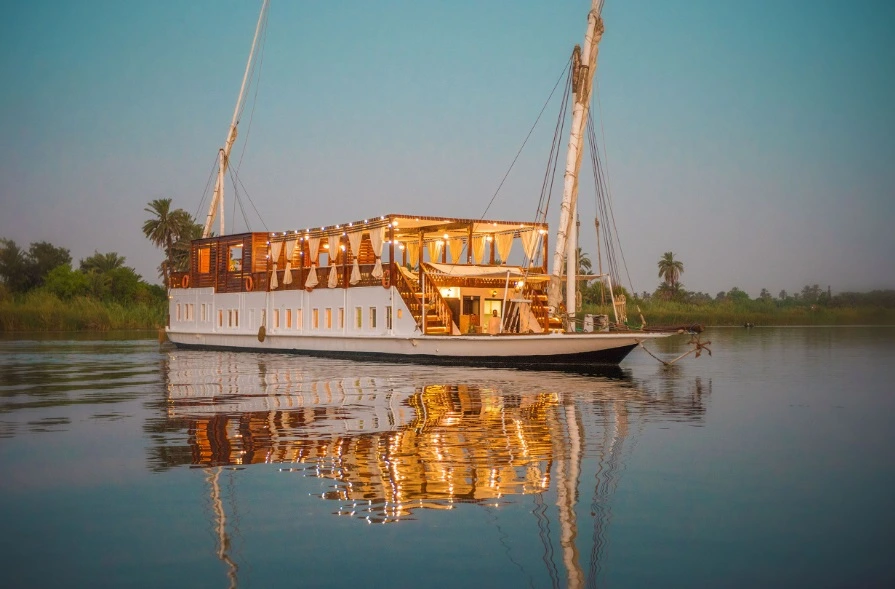
Open-Air Decks
The deck is often one of the most enjoyable parts of the experience.
You can sit in the shade during the day, enjoy the river scenery, read a book, or watch the sunset.
In the evening, the deck can become an ideal place for dinner or quiet conversation.
Meals on Board
Dining is another important part of the dahabiya experience.
Many luxury dahabiyas focus on fresh meals and personalized service. Egypt's official tourism authority notes that dahabiya journeys can include elegant furnishings and meals prepared by private chefs.
Depending on the boat, meals may include Egyptian specialties alongside international dishes.
If you have dietary requirements, inform the tour operator before departure.
The Landscapes You Will See Along the Nile
One of the strongest reasons to choose a dahabiya is the opportunity to observe everyday life along the river.
Green Fields
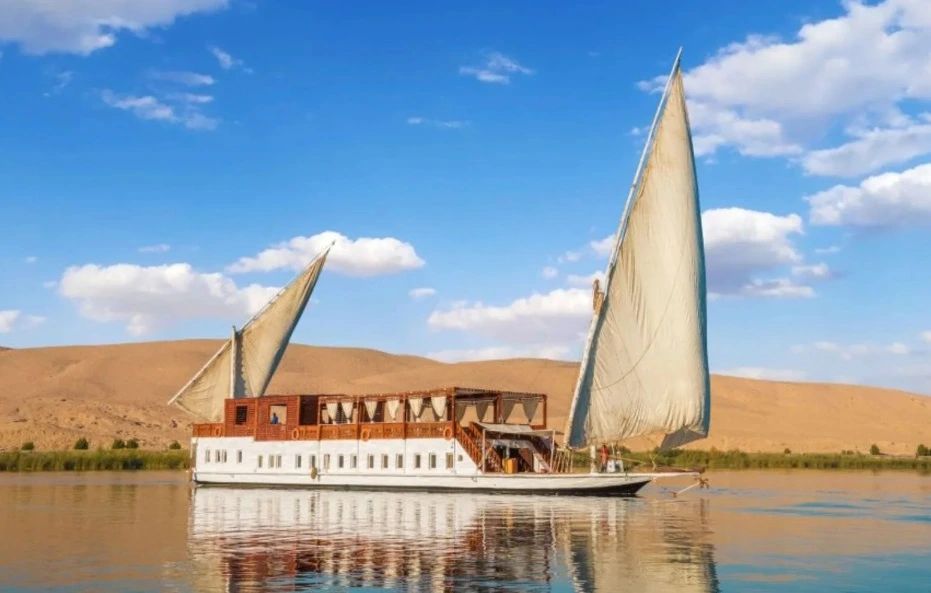
The Nile Valley creates a striking contrast with Egypt's surrounding desert.
From the deck, you can see agricultural land, palm trees, villages, and waterways passing slowly by.
Local Villages
Dahabiyas can sometimes stop near smaller communities where larger cruise ships cannot easily dock.
These stops provide an opportunity to see a different side of Egypt away from the major tourist attractions.
Islands
The Nile contains numerous islands, some of which can become peaceful stopping points during a dahabiya journey.
Walking on a quiet island can feel very different from visiting a major archaeological complex.
Desert Landscapes
As the green agricultural strip becomes narrower, desert landscapes become increasingly visible.
The contrast between fertile land and dry desert is one of the defining visual characteristics of southern Egypt.
Ancient Sites You Can Visit
A dahabiya cruise is not only about relaxation.
The classic Luxor-to-Aswan route provides access to some of Egypt's most important ancient monuments.
Luxor
Luxor is one of the most important archaeological destinations in Egypt.
Depending on your itinerary, you may visit:
- Karnak Temple
- Luxor Temple
- Valley of the Kings
- Hatshepsut's Temple
- Colossi of Memnon
The official tourism authority identifies Luxor's Valley of the Kings, Luxor Temple, and Karnak Temple among the principal sites visited during Nile cruises.
Esna
Esna is associated with the Temple of Khnum and can be included in some itineraries.
The temple provides an interesting look at Egypt's later religious history.
Edfu
Edfu Temple is dedicated to Horus and is one of the best-preserved ancient Egyptian temples.
Its monumental walls and reliefs make it one of the most impressive stops along the Nile.
Kom Ombo
Kom Ombo is famous for its unusual double temple dedicated to Sobek and Horus.
The location beside the Nile makes it particularly atmospheric around sunset.
Aswan
Aswan provides a beautiful conclusion to a Nile journey.
Depending on your itinerary, you can visit:
- Philae Temple
- The Unfinished Obelisk
- Aswan High Dam
- Nubian villages
- Local markets
- Nile islands
Why Travelers Choose a Dahabiya
A Slower Pace
Modern holidays can sometimes feel rushed.
You arrive at one attraction, take photographs, move to another site, eat quickly, and continue traveling.
A dahabiya offers the opposite rhythm.
You have time to watch the landscape and enjoy the journey itself.
A More Intimate Atmosphere
With fewer passengers, it is easier to get to know fellow travelers and crew.
For couples or small groups, this can create a more personal holiday.
Access to Quieter Places
The smaller size of a dahabiya makes it possible to reach locations that larger ships may not visit.
This is one of its strongest advantages for travelers looking for something beyond the standard Nile cruise route.
A Connection With the River
Perhaps the most important difference is psychological.
On a large cruise ship, the Nile can sometimes feel like scenery outside the window.
On a dahabiya, the river becomes the central part of your journey.
Crowds, Distances, and Daily Rhythm
Crowds
Dahabiyas generally have fewer passengers than conventional Nile cruise ships.
However, the archaeological attractions themselves can still be busy.
For example, major sites in Luxor and Aswan may receive visitors from multiple cruise boats and land-based tours.
One advantage of traveling by dahabiya is that your time away from major sites can be considerably quieter.
Distances
Luxor and Aswan are separated by roughly 230 kilometers by road, while the river route is longer and follows the winding Nile.
The exact sailing duration depends on the route, wind, stops, and itinerary.
Unlike road travel, the goal is not simply to arrive quickly.
The journey is part of the holiday.
Daily Schedule
A typical day may include:
- Breakfast
- Morning sightseeing or sailing
- Lunch
- Afternoon sailing or an excursion
- Sunset viewing
- Dinner
- Evening relaxation
The exact schedule varies between boats.
Weather on the Nile
Egypt has a generally sunny climate, but conditions vary between seasons and regions.
The official tourism authority describes Egypt's winter as mild and its summer as hot and dry, with southern areas remaining warm for much of the year.
For Nile cruising, October through May is generally considered the more comfortable period.
Winter
Winter days are usually comfortable for sightseeing.
Evenings on the river can be cooler, so bring a light jacket.
Spring
Spring offers warm temperatures and pleasant sailing conditions, although some days can become hot.
Summer
Summer can be very hot, particularly in Upper Egypt.
If you travel during this season, early sightseeing and adequate hydration become especially important.
Practical Travel Tips for a Dahabiya Cruise
1. Choose the Boat Carefully
Not all dahabiyas offer the same experience.
Check:
- Number of cabins
- Cabin size
- Private bathroom
- Air conditioning
- Deck space
- Dining arrangements
- Sailing style
- Wi-Fi availability
- Number of passengers
- Included excursions
2. Ask About the Exact Route
Some itineraries follow the classic Luxor-Aswan route, while others include quieter stops.
Ask for the complete itinerary before booking.
3. Pack Light
Cabins on smaller vessels can have less storage than large cruise ships.
A soft-sided suitcase is often easier to manage than a large hard case.
4. Bring Sun Protection
Pack:
- Sunglasses
- Sunscreen
- Hat
- Lightweight clothing
- Comfortable walking shoes
Egypt's official tourism guidance also recommends sun protection and comfortable footwear for sightseeing.
5. Bring a Light Jacket
Even in warm seasons, evenings on the river can feel cool because of the breeze.
6. Keep Comfortable Shoes
Your dahabiya may be peaceful, but the archaeological excursions involve walking.
Comfortable shoes are essential.
7. Tell Your Operator About Dietary Needs
If you require vegetarian, vegan, gluten-free, or other meals, communicate this before the journey.
8. Do Not Expect a Big-Ship Resort
A dahabiya is about intimacy and authenticity.
If you want large swimming pools, extensive entertainment, nightclubs, and numerous onboard facilities, a conventional luxury Nile cruise may offer a different experience.
Real Insights From Travelers
One of our travelers mentioned that the biggest surprise was how quickly the journey became part of the holiday rather than simply transportation between temples.
Visitors often say that watching the sunset from the deck is one of the most memorable moments of the trip.
Another common observation is that the smaller size of the boat creates a more relaxed social atmosphere. Guests often have more opportunities to speak with one another and interact with the crew.
Some travelers also appreciate the ability to stop in quieter places.
Instead of spending every day surrounded by large groups, a dahabiya journey can provide moments where the river, landscape, and local villages seem to belong entirely to the experience.
For travelers interested in photography, the changing light is another highlight. Early mornings can reveal misty river scenes, while late afternoons bring warm colors across the water.
Who Should Choose a Dahabiya Nile Cruise?
A dahabiya can be an excellent choice for travelers who value:
- Peaceful sailing
- Smaller groups
- Privacy
- Authentic cultural experiences
- Scenic landscapes
- Flexible itineraries
- Luxury without a large-ship atmosphere
- Slow travel
- Photography
- Romantic journeys
- Family celebrations
- Special occasions
It is particularly attractive to couples celebrating an anniversary or honeymoon and travelers who have already experienced a conventional Nile cruise and want something more intimate.
Who Might Prefer a Traditional Nile Cruise?
A conventional Nile cruise may be more appropriate if you prefer:
- Larger swimming pools
- More onboard entertainment
- Larger restaurants
- More extensive facilities
- A bigger social environment
- A highly structured schedule
Neither experience is identical.
The right choice depends on the type of holiday you want.
If the river scenery, privacy, and peaceful atmosphere are more important than extensive onboard facilities, a dahabiya may suit your travel style.
How to Plan the Perfect Dahabiya Experience
Start in Luxor
Many travelers begin their journey in Luxor because it allows them to explore the city's major archaeological sites before boarding the boat.
Consider spending at least two nights in Luxor if your schedule allows.
Sail Toward Aswan
Once onboard, allow yourself to slow down.
Do not treat every sailing hour as downtime between excursions.
Enjoy the river.
Add Aswan
After reaching Aswan, continue exploring the region.
Philae Temple is particularly worthwhile, and you can also consider a Nubian experience or additional local sightseeing.
Combine With Cairo
A dahabiya works beautifully as part of a longer Egypt itinerary.
A classic journey could include:
Cairo → Luxor → Dahabiya Nile Cruise → Aswan → Abu Simbel
This combination brings together modern Cairo, ancient temples, the Nile Valley, and Nubian landscapes.
Frequently Asked Questions About Dahabiya Nile Cruises
What is a dahabiya?
A dahabiya is a traditional-style Nile sailing boat, usually with two masts, adapted today for comfortable and intimate cruising between Luxor and Aswan.
Is a dahabiya better than a regular Nile cruise?
The two experiences are different. A dahabiya emphasizes smaller groups, quiet sailing, intimate service, and access to less-visited locations, while conventional cruises generally provide larger facilities and more structured onboard experiences.
How many people are on a dahabiya?
The number varies by vessel. Dahabiyas are generally much smaller than standard Nile cruise ships, but passenger capacity depends on the specific boat.
How many nights should I spend on a dahabiya?
The ideal duration depends on your itinerary and interests. Several nights allow you to enjoy the sailing experience while visiting major sites between Luxor and Aswan.
Can I charter a private dahabiya?
Yes. Egypt's official tourism authority notes that private dahabiyas can be chartered, making them suitable for families, groups, celebrations, and travelers seeking a more exclusive experience.
Is a dahabiya suitable for couples?
Yes. The peaceful atmosphere and smaller scale make dahabiyas particularly appealing for couples seeking a romantic Nile experience.
Is a dahabiya suitable for families?
Many boats can accommodate families, although you should check cabin arrangements, child policies, and onboard facilities before booking.
What should I pack for a dahabiya?
Bring comfortable walking shoes, lightweight clothing, sunscreen, sunglasses, a hat, swimwear if the boat has suitable facilities, and a light jacket for cooler evenings.
What is the best time for a dahabiya Nile cruise?
October through May is generally recommended for comfortable Nile cruising.
Do dahabiyas visit the major temples?
Many itineraries include major attractions such as Edfu, Kom Ombo, Luxor, and Aswan, although the exact route depends on the boat and program.
Are dahabiyas luxurious?
Many modern dahabiyas offer upscale accommodation, elegant interiors, private cabins, and personalized dining. However, facilities differ between boats, so travelers should review the exact vessel before booking.
Final Thoughts: Why a Dahabiya Is More Than a Nile Cruise
A dahabiya Nile cruise offers something that is difficult to measure in a standard itinerary: time.
Time to watch the river.
Time to see villages pass quietly in the distance.
Time to enjoy a sunset without rushing to the next attraction.
Time to appreciate the Nile as an essential part of Egypt's history and daily life.
The official Egyptian tourism authority describes dahabiyas as intimate, exclusive sailing experiences that can reach quieter villages, islands, and lesser-known sites along the river.
That is what makes this style of travel so appealing.
You still have the opportunity to visit extraordinary places such as Luxor, Edfu, Kom Ombo, and Aswan, but the journey between them becomes an experience in its own right.
If you are looking for a more personal and authentic way to discover Egypt, a dahabiya can transform a traditional Nile itinerary into a slower, more memorable adventure.
Ready to experience the Nile at a different pace? Explore Egypt with Flying Carpet Tours and let us help you arrange a carefully planned dahabiya Nile cruise, combined with professional guides, comfortable transportation, and unforgettable visits to Egypt's ancient treasures. Discover the beauty of the Nile and create your own unforgettable sailing story with Flying Carpet Tours.